[00:00:00] Most agencies have tough time telling
[00:00:03] technical stories. AI generated content
[00:00:06] is all around us and like in 2025 slop
[00:00:10] was the the word of the year.
[00:00:12] >> Where in the developers journey do you
[00:00:14] think video creates most value? Is it
[00:00:16] awareness? Is it evaluation? Is it
[00:00:18] onboarding?
[00:00:19] >> You need someone who's going to connect
[00:00:21] with the audience.
[00:00:24] Hey everyone, today we're talking about
[00:00:26] something almost every dev tool company
[00:00:28] is investing in, but very few are doing
[00:00:30] well, which is video. Almost every
[00:00:32] company has a YouTube channel. Every
[00:00:34] startup is producing demos, product
[00:00:36] launches, tutorials, webinars, and so
[00:00:38] much content. But very little of that
[00:00:40] content actually gets watched by
[00:00:42] developers. So, how do you create
[00:00:44] technical videos that developers
[00:00:45] genuinely want to watch and more
[00:00:47] importantly that actually drive adoption
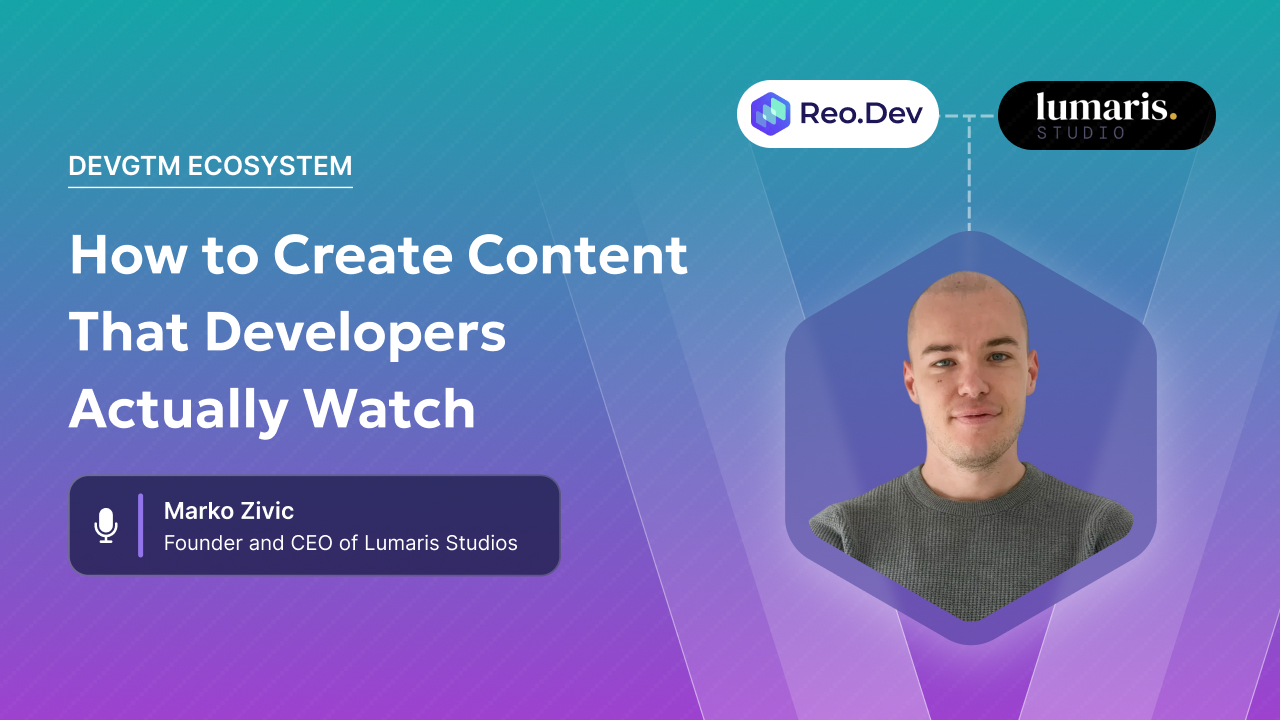
[00:00:50] and revenue? Joining me today is Marco
[00:00:52] Zeik, founder and CEO of Lumar Studio.
[00:00:55] Marco spent nearly a decade as a
[00:00:57] software engineer and engineering leader
[00:00:59] before deciding to build a studio
[00:01:01] entirely on technical video for dev
[00:01:03] tools, DevOps, AI infrastructure and
[00:01:05] security companies. Marco, it's so great
[00:01:08] to have you here today with us.
[00:01:10] >> No, the pleasure is all mine. Disha,
[00:01:12] thank you so much for such an amazing
[00:01:14] introduction. Uh, I really appreciate
[00:01:16] it. Uh and yeah, you you nailed it
[00:01:19] basically about the things we do. Um so
[00:01:23] yeah, once again, just to be like
[00:01:25] formal, thank you for having me. It's a
[00:01:27] pleasure to be here in front of your uh
[00:01:30] great audience. Um yeah, as you
[00:01:33] mentioned, senior developer, decade of
[00:01:35] experience, was leading teams at GitHub,
[00:01:39] setup actions and code spaces teams, and
[00:01:41] now I run Lumari Studio with my uh
[00:01:45] lovely wife. Um basically
[00:01:49] um we we do just a a very narrow segment
[00:01:53] of video editing which is like
[00:01:56] completely focused on technical content
[00:01:58] for developer audiences. Uh what we are
[00:02:02] so proud to say and what makes us uh
[00:02:07] distinguishable on the market uh is the
[00:02:09] fact that our video looks stunning. Um
[00:02:13] it clearly explains technical concepts.
[00:02:16] So it's not like just we do editing. No,
[00:02:19] we pay a lot of attention to how
[00:02:22] concepts are explained where we should
[00:02:25] take it easier so people would have time
[00:02:27] to understand to process stuff. Um also
[00:02:31] uh we have this zero syntax errors
[00:02:35] guarantee from the first draft which is
[00:02:38] essential in this niche and nobody does
[00:02:39] it. Um we also
[00:02:43] uh have extremely uh high focus on uh
[00:02:47] keeping developers interested and hooked
[00:02:50] during the video itself. Um and and like
[00:02:54] also uh what one thing that's also very
[00:02:57] important to note is that our delivery
[00:02:59] times are like five days on average with
[00:03:03] a single revision round where the
[00:03:06] industry average is like weeks even
[00:03:09] months and like four to six uh revision
[00:03:12] rounds. Um and yeah, our customers are
[00:03:16] just uh dev tool companies, DevOps
[00:03:19] companies, security, AI. Um yeah, one
[00:03:23] more thing I forgot to mention um that
[00:03:26] that is also very important um and it
[00:03:29] separates us from most agencies is that
[00:03:32] most agencies have tough time telling
[00:03:35] technical stories. Like you can see
[00:03:38] clearly that they they're just doing
[00:03:41] stuff like to to to edit and not to
[00:03:45] explain and tell the story and explain
[00:03:48] it so that the viewer would understand
[00:03:50] and be able to follow along and nobody
[00:03:53] on their team usually can do that.
[00:03:56] Luckily we managed to create team of
[00:03:59] people that can do it and we also have
[00:04:01] developer team inhouse that for those
[00:04:04] like extreme cases for some complex
[00:04:07] products uh we can always like dive deep
[00:04:10] and uh explain concepts internally and
[00:04:13] not have to to ask the customer to do
[00:04:16] handholding and guide us and explain
[00:04:19] everything. So we are saving their time
[00:04:21] and also making video that is telling a
[00:04:25] story in the in the right way. Got
[00:04:28] >> very interesting Marco and um would love
[00:04:31] to understand you know about your
[00:04:32] journey a bit because you've gone from
[00:04:34] writing production code at GitHub to
[00:04:36] building a video company. It's not a
[00:04:38] career path you see every day. So you
[00:04:40] know what led to this transition? Yeah,
[00:04:43] like it's it's a very funny story that
[00:04:45] that was not uh it was not a business
[00:04:49] idea. It was a problem that that I had
[00:04:52] because um a few years ago I like
[00:04:56] throughout my decade of experience I had
[00:04:58] four tech YouTube channels and the last
[00:05:01] two were for Rust and forn net and
[00:05:04] JavaScript and basically finding video
[00:05:08] editors who were able to to do editing
[00:05:11] for such a content was mission
[00:05:13] impossible and uh and I I basically had
[00:05:16] to hire someone um like locally who who
[00:05:21] could do video editing and the guy I
[00:05:24] hired initially is a very talented guy.
[00:05:26] He does video editing greatly. Like he
[00:05:28] produced some amazing video and I was
[00:05:30] like this guy can do it. And then there
[00:05:33] is this story that I love sharing. Um
[00:05:37] where he was supposed to animate code
[00:05:39] execution and I I never had a doubt that
[00:05:43] he would see anything else except like
[00:05:47] code getting executed and running. No,
[00:05:50] the end video had like a person with a
[00:05:53] screen instead of their head and on the
[00:05:55] screen there was code written and this
[00:05:57] person was standing on the edge of the
[00:05:59] cliff and when code was supposed to get
[00:06:02] executed this person jumped off a cliff
[00:06:05] >> and that's that's the moment where my
[00:06:08] wife and I were like just laughing our
[00:06:10] asses off and like the the editor was
[00:06:13] sitting there being all confused and and
[00:06:15] we just explained to him what code
[00:06:18] execution is And then he started
[00:06:20] laughing as well. Um but that that was
[00:06:23] the moment where where it clicked for me
[00:06:26] and uh I I figured that skill uh does
[00:06:29] not exist in the market or is extremely
[00:06:32] rare to find. Um like editors you can
[00:06:36] find everywhere. There is like people
[00:06:38] fighting everywhere online to find video
[00:06:41] editing gigs. But editors who can
[00:06:43] understand like technical concepts, who
[00:06:46] know what a function is or code
[00:06:48] execution, um they're very rare uh to
[00:06:52] find. So, so that's that's the core
[00:06:56] piece of information I had in the back
[00:06:58] of my head. And Lumaris did not came to
[00:07:01] existence then like uh because we still
[00:07:05] had to do editing. My wife and I had to
[00:07:08] learn to edit video ourselves. uh she's
[00:07:11] a front-end developer. I forgot to
[00:07:13] mention that she was a front-end
[00:07:15] developer and when she learned to do
[00:07:17] video editing, she started enjoying it
[00:07:20] and uh she fell in love with it and
[00:07:22] wanted to quit doing front-end stuff and
[00:07:25] do video editing full-time. So, that's
[00:07:28] that's basically when I I was supposed
[00:07:32] to be a person finding work for her and
[00:07:35] a technical guy that I am. I I was not
[00:07:38] looking forward to that at all. So I I
[00:07:42] had no sales experience, no idea how to
[00:07:44] find people. So my approach was I'll
[00:07:47] collect a list of YouTube channels for
[00:07:49] technical content that I and her enjoy
[00:07:52] watching that we really follow and I'll
[00:07:55] send called emails.
[00:07:57] >> And I sent 20 called emails and out of
[00:08:00] those like we landed five customers.
[00:08:04] >> Wow. That's great conversion cycle.
[00:08:06] Yeah.
[00:08:08] >> Yeah. And and like that was completely
[00:08:10] cold and that's not me being an amazing
[00:08:14] sales guy because like I can easily sell
[00:08:17] a course right now. How to close 20% of
[00:08:22] your cold email outreach like in 2026.
[00:08:25] That would be like insane to to to to
[00:08:27] people would be lining up to buy that.
[00:08:29] But yeah, it's not me sadly. It was just
[00:08:32] a sign that market desperately
[00:08:35] uh needed this service. It was starving
[00:08:38] for for for this kind of talent. Uh so
[00:08:41] basically yeah after that we spent a
[00:08:44] couple of years heads down uh doing
[00:08:46] editing for those channels. Uh along the
[00:08:49] way I was the one responsible for
[00:08:51] building systems, SOPs, defining the
[00:08:54] overall experience so that basically um
[00:08:58] everyone would be as happy as possible.
[00:09:02] Uh we started hiring people because we
[00:09:05] we had more work than we can handle. Uh
[00:09:09] and and then basically we built
[00:09:10] something that was more valuable than
[00:09:12] than editing itself. We built a team of
[00:09:15] people who were able to understand
[00:09:17] technical concepts, do editing uh in a
[00:09:21] way that's going to resonate with
[00:09:23] technical audience and basically produce
[00:09:27] video that looks stunning that performs
[00:09:30] extremely well. And because my wife
[00:09:33] spent some time like on front end while
[00:09:35] she was um learning to be a front-end
[00:09:38] developer, she developed her skills on
[00:09:40] emotional side of UI UX. Got it.
[00:09:44] >> And then she applied that to video. And
[00:09:47] that way like even now she's like still
[00:09:50] by far the best in in company when it
[00:09:53] comes to understanding the emotion
[00:09:55] that's going to be extracted from the
[00:09:57] viewer when they see some uh segment of
[00:10:00] the video or or how to get them keep
[00:10:03] watching. And that's why we we managed
[00:10:05] to achieve like 99% retention rate on
[00:10:09] technical video intro sections. Like
[00:10:11] insane results.
[00:10:14] Um and uh yeah this this combo was was
[00:10:18] what what made this come to come to
[00:10:20] life. Um and uh here we are.
[00:10:24] >> Very interesting story Marco and it's so
[00:10:26] amazing to see you speak about video
[00:10:28] content so passionately you know and
[00:10:30] talking about retention and talking
[00:10:32] about you know what emotion is being
[00:10:34] extracted because I I haven't seen a lot
[00:10:36] of people talk about video content that
[00:10:38] way specifically you know when it comes
[00:10:40] to technical content. So I'm I'm sure
[00:10:42] you know there's going to be a lot of
[00:10:44] interesting conversation um you know
[00:10:46] going forward. So look forward to it. Um
[00:10:48] so my next question to you Marco is that
[00:10:50] you know um just wanted to zoom out a
[00:10:52] bit. You know developers consume
[00:10:54] information very differently today than
[00:10:56] they were doing 5 years ago. Do you feel
[00:10:58] that has changed and would also love to
[00:11:01] understand where do you feel video fits
[00:11:02] in? because you know there's already a
[00:11:04] lot of content which um we sort of hear
[00:11:08] that is very important for developers be
[00:11:10] it your documentation be it GitHub be it
[00:11:13] blogs etc. So where does video fit in
[00:11:16] all of this?
[00:11:18] Yeah, first of all, the part about video
[00:11:21] changing, you're absolutely on point. Uh
[00:11:25] like it has changed dramatically over
[00:11:27] the past five years. U and it made our
[00:11:31] jobs a lot harder, not easier. Uh the
[00:11:34] the two two main things that that I I
[00:11:37] saw firsthand happening um are first
[00:11:41] like everyone started watching short
[00:11:43] form content and that is like fast
[00:11:48] constant stimulation.
[00:11:50] uh people receiving a hit of dopamine
[00:11:52] every few seconds and that maybe did not
[00:11:57] damage their attention span, but at
[00:11:59] least it gave them zero tolerance when
[00:12:03] it comes to being bored
[00:12:05] >> and like technical video is opposite of
[00:12:08] that because it's like substantial. Uh
[00:12:13] it it provides dense slow
[00:12:17] um content that is supposed to teach you
[00:12:20] and it cannot always be all the time
[00:12:22] like explosions happening and being like
[00:12:25] things flying in dynamically because
[00:12:28] like if you need someone to learn
[00:12:30] something, you need to give them time
[00:12:32] and space to process the information
[00:12:34] that you're giving them. and and that
[00:12:37] that is basically why the content cannot
[00:12:40] easily be made uh attentiongrabbing and
[00:12:44] like to to invoke people wanting to keep
[00:12:47] watching it while still being effective
[00:12:50] at telling the story properly and
[00:12:52] teaching them properly. So
[00:12:55] basically the bar that uh that is
[00:13:00] holding uh attention of developers
[00:13:03] uh has risen significantly in the past
[00:13:06] three to five years uh since the the the
[00:13:10] explosion of Tik Tok and short short
[00:13:13] form content. Um, basically it is it is
[00:13:15] so obvious that like uh I've seen many
[00:13:19] YouTube channels where a company serious
[00:13:22] company uh has a consistent
[00:13:25] production uh approach for their video
[00:13:28] and like 5 years ago they were producing
[00:13:31] exactly the same video as they produce
[00:13:33] right now. Back then let's say in 2022
[00:13:37] that video would bring them in like
[00:13:41] 200,000 views. That same video right now
[00:13:44] brings them in like 100 views and it's
[00:13:46] exactly the same. It's the same speaker,
[00:13:49] same approach of editing. Everything is
[00:13:51] the same. The only thing that has
[00:13:53] changed is YouTube's algorithm and
[00:13:56] people's
[00:13:57] approaches and expectations when it
[00:14:00] comes to the quality of content. So same
[00:14:04] quality, the audience just got harder to
[00:14:06] to to hold. Um that that was the the
[00:14:10] first point. And the second one um and
[00:14:13] like th this one is is even a newer
[00:14:16] shift that is taking place is dedicated
[00:14:19] to AI um because AI generated content is
[00:14:23] all around us
[00:14:25] >> and like in 2025 slop was the the word
[00:14:29] of the year. So it tells you that there
[00:14:32] is something going on there. Um and
[00:14:34] yeah, there is also like this paper I I
[00:14:37] stumbled upon uh iHeart Media published
[00:14:40] that they're launching um a guaranteed
[00:14:44] human campaign where because like 90% of
[00:14:48] their audience said that they want just
[00:14:50] humanmade
[00:14:52] um media. They do not care about AI
[00:14:55] content even though those people are
[00:14:57] like working on creating AI generated
[00:14:59] content and like consuming AI all the
[00:15:02] time. This is not just a vibe or a
[00:15:05] feeling like there are numbers hard
[00:15:07] numbers like companies performed
[00:15:09] exhaustive research on this and numbers
[00:15:12] completely go along with this story like
[00:15:15] AI generated video has 70% lower
[00:15:19] retention rate than human fronted video.
[00:15:22] That was not the case like year ago when
[00:15:25] it was new. people were like hooked to
[00:15:28] AI generated video because when you see
[00:15:31] uh talking gorilla you're like this is
[00:15:33] amazing but right now everyone is doing
[00:15:37] it just became something that people do
[00:15:40] not enjoy.
[00:15:41] >> Got it. So, but do you feel that you
[00:15:43] know AI has helped made video generation
[00:15:46] or video content generation better or
[00:15:48] has it just increased more mediocre
[00:15:50] content um you know flowing around
[00:15:53] >> for technical uh video it's extremely
[00:15:58] singlesided because the the the
[00:16:01] improvements that AI can bring are not
[00:16:04] nearly as relevant for technical content
[00:16:08] as it is for something ordinary like
[00:16:11] social media marketing and all those
[00:16:14] kinds of deal things. For let's say
[00:16:16] regular uh non-technical
[00:16:20] uh products because for technical
[00:16:22] content you you need uh to to build uh
[00:16:27] relationship with audience to position
[00:16:29] yourself as someone who's trustworthy.
[00:16:32] You need a person that is going to
[00:16:34] humanize your brand. You need someone
[00:16:36] who's going to connect with the
[00:16:38] audience. they can feel relatable uh
[00:16:41] with that person and AI doesn't build
[00:16:44] it. So there is this story about a
[00:16:46] company that I had a talk a few months
[00:16:49] ago uh about potential collaboration and
[00:16:52] they decided to go uh with another
[00:16:54] company and produce a demo for their
[00:16:57] product which is extremely technical AI
[00:17:01] based databaseoriented
[00:17:04] uh product and the video that is a demo
[00:17:07] like on their homepage was a Pixar style
[00:17:10] cartoon video and they're selling to
[00:17:14] companies like Nvidia, IBM, like the
[00:17:17] biggest names in the industry and and I
[00:17:20] just sat there being like I I would pay
[00:17:23] so much money to be present on the sales
[00:17:26] call where they go on a call with some
[00:17:28] old guy from like IBM and be like this
[00:17:32] is our demo video. Take a look at it and
[00:17:35] there is a cartoon guy explaining that
[00:17:37] it has like issues with their database
[00:17:40] reliability. And I was like this is just
[00:17:44] not going to resonate ever on any kind
[00:17:47] of situation. Uh but yeah uh it is it is
[00:17:50] happening all around us. It is and it
[00:17:53] can speed up the process. Like you can
[00:17:56] make video editing faster because you
[00:17:58] can generate specific segments of it.
[00:18:01] But if you do not include human touch to
[00:18:04] to make it all fit together, to make it
[00:18:07] all look serious, polished like to build
[00:18:11] that emotional moment that I was talking
[00:18:14] about and to show off that understanding
[00:18:16] of the audience, the video is just not
[00:18:18] going to perform. Like that's that's the
[00:18:20] reality of it. So yeah, it's happening
[00:18:23] all around us, but I'm I'm seeing more
[00:18:26] YouTube channels that are pumping out
[00:18:28] content like that. There is so many of
[00:18:30] them and they're like averaging 10, 20,
[00:18:33] 50 views on their video.
[00:18:36] >> So it's just not working. And they're
[00:18:38] like, we're investing heavily in video,
[00:18:41] but it's just not working. Yeah. Well,
[00:18:43] you're not building video that is going
[00:18:45] to get the retention high and signal to
[00:18:50] YouTube that people are enjoying to
[00:18:52] watch your content and then push your
[00:18:54] content to even more people.
[00:18:57] >> So, that's the issue.
[00:18:57] >> It's all about you know understanding
[00:18:59] target audience and understanding what
[00:19:01] is going to resonate with them rather
[00:19:03] than saying that you know hey I'm able
[00:19:05] to do these 10 things let me just push
[00:19:07] that. So I do understand
[00:19:09] >> yeah the distinction. Perfect. Um so
[00:19:11] Malcolm my next question is that you
[00:19:13] know where in the developers journey do
[00:19:15] you think video creates most value? Is
[00:19:17] it awareness? Is it evaluation? Is it
[00:19:19] onboarding? Is it customer expansion?
[00:19:21] Where do you see most video content
[00:19:23] creation happening?
[00:19:24] >> Where it is beneficial? The answer is
[00:19:27] yes in all of those areas. But uh where
[00:19:30] where I see it the most I think uh it
[00:19:34] can be like top of the funnel midfunnel.
[00:19:38] That's where like people invest the most
[00:19:40] of their effort at like at the top where
[00:19:44] it comes to awareness. Video is the the
[00:19:46] the fastest way to build trust with with
[00:19:49] your audience because a developer can
[00:19:52] watch a short video or a 10 minute video
[00:19:54] tutorial and make a decision right there
[00:19:58] if that product is going to be helpful
[00:20:01] for them and for them to start using it.
[00:20:03] which is a lot faster than reading any
[00:20:05] blog or seeing any ad in different ways.
[00:20:08] Like ad doesn't build trust. Blogs are
[00:20:11] like people stopped reading nearly as
[00:20:14] much as as they did before. And video is
[00:20:17] like the sweet spot. It's like you can
[00:20:19] see the technical part. You can see the
[00:20:21] depth if you want it, but it's not
[00:20:23] exhaustive. It's not something that you
[00:20:26] have to be like consciously making
[00:20:28] decision. I'm going to sit and read this
[00:20:30] blog post to to ingest information. Then
[00:20:33] then we have the middle uh segment which
[00:20:35] is like evaluation part and it's
[00:20:38] basically reassurance. Developers have
[00:20:40] found a product and they're making a
[00:20:43] decision in their mind if this product
[00:20:45] is going to bring benefits to them. Is
[00:20:48] it worth the investment of time to to
[00:20:51] learn a new tool or pay subscription for
[00:20:54] it or something like that? And basically
[00:20:56] the the whole point there is to make an
[00:20:59] honest video that is going to close that
[00:21:02] gap and show what your product does,
[00:21:04] show how to use it. So a person can like
[00:21:08] honestly not like just trying to say
[00:21:11] that everything is perfect and your
[00:21:13] solution is solving all their problems
[00:21:15] even though it has limitations and they
[00:21:17] know it. like if you do it honestly and
[00:21:19] people uh start using it then it then
[00:21:22] it's like just a great story for for
[00:21:25] everyone. And then there is the third
[00:21:27] type which is after the sale has
[00:21:30] happened uh which is like onboarding
[00:21:32] videos, enablement videos th those kinds
[00:21:36] uh of things and in my opinion from what
[00:21:39] I see those are severely underused
[00:21:43] because good tutorials are something
[00:21:47] that can cut out a lot of support like
[00:21:51] that is necessary for a serious product.
[00:21:53] Like if you have a great video library
[00:21:55] that teaches people how to use your
[00:21:58] product and it the video is great and
[00:22:00] inviting and easy to ingest, then people
[00:22:04] are just going to do it and not have to
[00:22:06] bother you. Hey, how can I do this? And
[00:22:08] then you have to have teams that are
[00:22:10] going to teach them and be there for
[00:22:12] them. And also if you educate them, your
[00:22:15] churn rates are going to be diminished
[00:22:18] because like people are going to be
[00:22:21] hooked to you because of the great
[00:22:23] experience they have because like I'm a
[00:22:26] developer. I I don't like having to use
[00:22:29] support to understand how to use your
[00:22:32] tool. I I want to be able to figure it
[00:22:34] out on my own, watch a video, see how it
[00:22:38] works, and do it on my own. like it's
[00:22:40] it's extreme example of going out of my
[00:22:43] comfort zone if I have to be on a call
[00:22:46] with someone so I can use your tool. So
[00:22:49] yeah, this third point is where where I
[00:22:52] can see that most companies
[00:22:56] um get wrong. Like this is where they in
[00:22:59] their video they start with themselves.
[00:23:02] Like most of the industry starts their
[00:23:05] video with a logo flying in and then
[00:23:07] they present the product like
[00:23:10] >> this is our funding story. We worked so
[00:23:13] hard to build this product for you. And
[00:23:16] the viewer is like I I don't care really
[00:23:19] like tell me what is in it for me like
[00:23:22] you you have to start the story about
[00:23:24] the user what problem you are solving
[00:23:27] and then start with the problem and if
[00:23:30] the user connects to that problem they
[00:23:33] feel like they have the same problem
[00:23:34] they're going to keep watching like you
[00:23:37] then then you make a big reveal of your
[00:23:39] product that is the solution to that
[00:23:41] problem.
[00:23:42] >> Yeah.
[00:23:42] >> And you made everything a lot better.
[00:23:44] That's why the retention can be designed
[00:23:49] from the beginning, from the ground up
[00:23:51] in your video. If you think about the
[00:23:53] customer first, not the product first.
[00:23:56] That's that's like a a basic rule that
[00:23:59] you have to follow.
[00:24:00] >> I think this answers my next question,
[00:24:01] which was going to be, you know, what
[00:24:02] separates a technical video that
[00:24:04] developers actually finish from the one
[00:24:06] they abandon, you know, after 30
[00:24:08] seconds. So, um, from what I'm
[00:24:10] understanding, it's about, um, it's not
[00:24:12] about going feature first. It's about
[00:24:14] understanding their problem and what is
[00:24:16] it that they are trying to solve and
[00:24:17] then starting from there.
[00:24:19] >> Yeah, exactly. But uh like this has also
[00:24:22] changed a bit uh from let's say a year
[00:24:26] and a half ago. Um, like if you asked me
[00:24:29] what kind of video works best, then
[00:24:33] >> I would say for the top of the funnel,
[00:24:35] just make a great demo video explaining
[00:24:38] your product in this exact way, like
[00:24:40] problem first, your product, the
[00:24:42] solution, and then add a call to action
[00:24:44] in the end that is going to invite them
[00:24:46] to start using it. And those are
[00:24:48] animated, dynamic, high production
[00:24:51] videos. But right now because again of
[00:24:53] the AI and people wanting that
[00:24:56] connection, I would not go as far as say
[00:24:58] it is still like that because right now
[00:25:01] what I can see in like datadriven video
[00:25:05] um the the thing that is performing the
[00:25:08] best is a person standing talking doing
[00:25:13] the work going through the the tool
[00:25:16] explaining showing like being a human
[00:25:20] like allowing people to connect with you
[00:25:22] is what is making video perform the best
[00:25:27] nowadays. And when people and companies
[00:25:30] build brands around people and those
[00:25:33] people are also included in the video
[00:25:37] that is optimized for performance and
[00:25:40] optimized for developer audiences and
[00:25:43] resonates with them, that video will
[00:25:45] work like it will just work. People will
[00:25:48] just feel the connection. they will not
[00:25:50] be bored and will keep watching.
[00:25:53] Retention is going to be high and
[00:25:56] YouTube is going to say kudos for you.
[00:25:58] I'm going to share that video with more
[00:26:00] people like that because they like what
[00:26:02] I see. That is again the the the reason
[00:26:04] for that is again AI backlash because
[00:26:07] like people just want real people and
[00:26:10] like also contributing factor to that is
[00:26:13] the fact that developers are the the
[00:26:16] least forgiving audience. Not because
[00:26:18] we're like skeptics overall, but because
[00:26:22] we we're there as things are being
[00:26:25] released and we're watching from the
[00:26:27] first row seats how AI is developing in
[00:26:31] front of us. So we have the most
[00:26:33] awareness about how it's impacting
[00:26:36] everything and like that's why we got
[00:26:40] bored of it first basically. That's
[00:26:42] >> got it makes sense. such an interesting
[00:26:44] insight because you know I think more
[00:26:45] and more videos are moving away from a
[00:26:47] human face uh and you know that's
[00:26:49] exactly the thing that's working. So
[00:26:51] then um I don't think a lot of people
[00:26:53] have come back to it because I think we
[00:26:55] were also evaluating some video creation
[00:26:58] agencies and then half of them uh were
[00:27:01] pushing to create videos which were
[00:27:03] animated or which did not have a human.
[00:27:05] Um, so I do understand, you know, that's
[00:27:07] that's something that people need to get
[00:27:09] back to
[00:27:10] >> like based on data from 2026. I I I went
[00:27:14] like a lot of through research findings
[00:27:17] and like format that wins like in in all
[00:27:21] fronts is a well-made video polished
[00:27:25] that is not just a person sitting and
[00:27:28] speaking for 10 minutes straight because
[00:27:30] like it's very tough to find people who
[00:27:32] are able to sit for 10 minutes and
[00:27:35] listen to someone not moving, not
[00:27:37] blinking, nothing happening on screen
[00:27:40] because of the whole that story like
[00:27:42] short form content. And we we need
[00:27:44] stimulation. But polished video which is
[00:27:48] like has dynamics in it that is being
[00:27:52] led by a credible technical person who
[00:27:57] knows what he's talking about and knows
[00:28:00] how to explain it properly. The honest
[00:28:03] part is also important like you're not
[00:28:06] trying to show your product in some
[00:28:09] sandbox environment where everything is
[00:28:12] glowing and then is working well but in
[00:28:14] reality it's not like that. So you need
[00:28:16] to be transparent and basically that is
[00:28:20] the format that is working the best like
[00:28:23] personality combined with the
[00:28:25] correctness and polish that's that's
[00:28:28] what is working right now the best
[00:28:30] across all fields. Got it. So, and
[00:28:33] Marco, when you sort of onboard a new
[00:28:35] customer at Lumaris, what is your
[00:28:37] process of um you know figuring out what
[00:28:40] is it that their um target audience
[00:28:42] would want to know and then creating
[00:28:44] those videos that will give retention?
[00:28:46] >> Uh yeah. So, what what we do initially,
[00:28:50] we have very strict process to on board
[00:28:52] a customer because we're we're not a
[00:28:55] regular agency. We do not like doing
[00:28:59] oneoff videos for people.
[00:29:01] >> That is because in order for us to be
[00:29:03] able to produce video that is going to
[00:29:05] work exceptionally well.
[00:29:07] >> Our team needs to learn your product. We
[00:29:10] need to understand what we are talking
[00:29:12] about in video. Not just be like he said
[00:29:16] this, I'll do this. Not like that. the
[00:29:19] editor who is dedicated to the customer.
[00:29:22] Like our customers have dedicated
[00:29:24] editors, one or more. And those people
[00:29:28] are learning your brand. They're
[00:29:29] learning your preferences. They are
[00:29:31] tracking results. What is working? What
[00:29:33] is not working? And they're learning
[00:29:35] your product. They're learning what
[00:29:36] resonates with it. What is important to
[00:29:38] say? What is the terminology that works?
[00:29:41] What is the terminology you should
[00:29:42] evade? And we create internal
[00:29:45] documentation for each customer
[00:29:47] containing technical data like about the
[00:29:50] product, about terminology and those
[00:29:52] things and also style bible which
[00:29:55] contains all the style preferences for
[00:29:58] that customer. And then we start every
[00:30:01] video from there. And that's why we're
[00:30:05] able to first of all not bother our
[00:30:07] customers to do a lot of handholding.
[00:30:09] There is always situations where they
[00:30:11] have some feature or product they want
[00:30:14] us to make video about that is not
[00:30:15] publicly available anywhere and they
[00:30:18] have no documentation for it. So they
[00:30:20] have to explain to us on a call. But
[00:30:23] that's like 5% of situations. Maybe in
[00:30:26] 95% of the situations we're more than
[00:30:29] able to understand everything and make
[00:30:32] video that's going to be great without
[00:30:34] the need to bother engineers and
[00:30:36] marketing departments in companies.
[00:30:38] Makes sense. Um, so Marco, you mentioned
[00:30:40] a very interesting thing that you know
[00:30:42] the editors are also uh tracking whether
[00:30:44] videos are working, not working. So what
[00:30:47] metrics should dev tool companies
[00:30:48] actually track to figure out whether
[00:30:50] video content is actually successful and
[00:30:52] how do these metrics uh, you know tie
[00:30:55] back to what they're doing in terms of
[00:30:57] revenue or adoption?
[00:30:58] >> Yeah, this is a very very good question.
[00:31:00] In our experience, it it comes down to
[00:31:03] two main things like comprehension is
[00:31:06] the first one. If editor starts editing
[00:31:09] before they understand the product, it's
[00:31:12] never going to to work well. And that's
[00:31:14] why whoever writes the story has to
[00:31:18] understand the the the smallest
[00:31:20] technical detail that is relevant for
[00:31:23] that story. And basically the approach
[00:31:25] that we have is we try to follow
[00:31:28] fineman's rule. If you cannot explain a
[00:31:30] concept to a 10-year-old so they can
[00:31:32] understand it about a technical product,
[00:31:35] you do not understand it well enough. So
[00:31:38] we we do our best to if our editors are
[00:31:41] unable to understand something then we
[00:31:44] start internally with our dev team. Our
[00:31:47] dev team starts using the tool in
[00:31:50] ingests everything we can find. We ask
[00:31:52] for access to their GitHub repo,
[00:31:55] documentation or anything. Developers
[00:31:57] try to understand to use the tool and
[00:32:00] then explain everything to editors. We
[00:32:03] make those documents that I mentioned in
[00:32:05] the process and only then we start the
[00:32:09] actual process of storyboarding because
[00:32:12] that's the only time when you can do it.
[00:32:14] And if you get to a point where you can
[00:32:16] easily explain everything about the
[00:32:18] product, basically half the story for a
[00:32:21] successful video is already checked.
[00:32:24] Like that's that's half the the the
[00:32:26] issue for a successful video. That's
[00:32:29] that's where our internal dev team comes
[00:32:32] really handy both in the process of
[00:32:35] explaining the video like concepts about
[00:32:37] the video. Uh also when it comes to
[00:32:40] technical accuracy of the video because
[00:32:43] after the editing is done before we send
[00:32:46] it to customers our developers test
[00:32:49] every technical diagram. Uh they check
[00:32:52] the code for accuracy for bugs syntax
[00:32:56] errors. We create a document that is
[00:32:58] delivered with every video that gives
[00:33:01] explicit statement to the customer what
[00:33:04] was tested, what's working and if
[00:33:06] something's not working, we flag it.
[00:33:08] Hey, you need to check this. Are we
[00:33:10] supposed to use this endpoint or this
[00:33:11] one? And that that makes it first of all
[00:33:15] first draft is accurate. Second of all,
[00:33:17] video is telling a story that makes
[00:33:19] sense to developers. And before we cut
[00:33:23] anything, we we already know that we are
[00:33:25] on the right track. And that's that's
[00:33:28] why no amount of motion graphics can
[00:33:31] save you if you do not nail that first
[00:33:34] part of understanding uh the the
[00:33:37] concept. Well, and the the second part
[00:33:40] that is as important after it goes away
[00:33:43] from our agency to the customer is
[00:33:46] related to viewer retention. I already
[00:33:48] mentioned this. Retention is the go-to
[00:33:51] metric that YouTube likes
[00:33:53] >> right now.
[00:33:54] >> Uh because um like there was a lot of
[00:33:58] history with likes, with comments, with
[00:34:01] uh shares of video and those metrics
[00:34:05] were easy to manipulate. You can pay
[00:34:08] people to do those. It turned out that
[00:34:11] retention is a source of truth that
[00:34:14] cannot be manipulated as easily. And uh
[00:34:18] basically it is a clear sign to YouTube
[00:34:21] that audience is enjoying the video.
[00:34:23] They're sticking with the video. They're
[00:34:25] watching it for extended periods of
[00:34:27] time. And basically that's that's what
[00:34:30] is the the main in story. Also
[00:34:33] clickthrough rate is important but not
[00:34:36] as important. If your clickthrough rates
[00:34:38] are good that means that your thumbnail
[00:34:41] is working well. Got it?
[00:34:43] >> Your title thumbnail. uh and that is
[00:34:45] also extremely important but when it
[00:34:48] comes to watching video that is
[00:34:50] retention is the whole game. If you for
[00:34:52] example go too fast brain cannot process
[00:34:55] what you're saying what you're doing in
[00:34:57] video that's wrong. If you go too slow
[00:35:00] people just went to start scrolling
[00:35:02] their Instagram instead of watching your
[00:35:04] video. So most people in what I see in
[00:35:08] in research and in reality is that most
[00:35:11] people are not quitting to to watch your
[00:35:13] video because of the video itself. They
[00:35:16] basically quit because they're bored.
[00:35:18] They they just
[00:35:22] and our job as as editors is to push
[00:35:24] that moment when they're bored as far
[00:35:27] ahead in the video as possible. And and
[00:35:30] it's not easy to nail it every time
[00:35:32] because it is enough to have a single
[00:35:34] moment in the video where the dynamics
[00:35:37] drop and it is just becoming slow and
[00:35:40] people you you will see decline on the
[00:35:43] on the curve for retention.
[00:35:45] >> What is a good benchmark for retention
[00:35:47] like how what what is the average and
[00:35:50] then what is like a good retention
[00:35:51] metric? Average in technical industry is
[00:35:54] about 20 to 40% in the in the first
[00:35:57] minute of video. Depends on the length
[00:35:59] of the video, but usually it's right in
[00:36:02] there. And like if you if you have video
[00:36:05] that's 40 to 60% you are doing fine. And
[00:36:09] everything above 60% is like amazing.
[00:36:12] For so many of our customers and videos,
[00:36:15] our retention rates are over 90 or even
[00:36:18] 95%. So that is a clear indicator both
[00:36:22] when it comes to retention and
[00:36:24] click-through rates. We managed to
[00:36:25] achieve like 13% fairly consistently
[00:36:28] where the average is 2 to 4% like two
[00:36:32] three sometimes 4%. So again a lot above
[00:36:37] the the average in this industry. Those
[00:36:39] are industry averages at the moment.
[00:36:42] >> Got it. Very interesting. And it's it's
[00:36:44] such a um you know hats off that you
[00:36:46] guys are just um so way beyond the
[00:36:49] industry averages and you've I think
[00:36:51] really cracked what it takes to have
[00:36:54] people one click the video and then also
[00:36:56] retain because I agree with you that you
[00:36:58] know um likes clicks shares etc is
[00:37:00] something that you can you can easily
[00:37:02] buy but if someone is actually giving
[00:37:05] you that time and watching the video
[00:37:07] that is the real success that you know
[00:37:09] they've found the video interesting they
[00:37:11] found it something that they resonate
[00:37:13] with and that's why still continuing to
[00:37:14] see. So
[00:37:15] >> yeah. Yeah. Exactly. Exactly. Uh I think
[00:37:17] YouTube agrees with you absolutely on
[00:37:20] that one.
[00:37:22] >> Perfect. Um so Marco I think one
[00:37:24] decision that companies also struggle
[00:37:26] with is that um you know so this content
[00:37:28] creation is like an ongoing part for dev
[00:37:30] tools right? Um so should they build an
[00:37:32] internal video capability? Should they
[00:37:34] partner with technical creators or
[00:37:36] should they work with specialized
[00:37:37] studios like yours? How should leaders
[00:37:39] think about these trade-offs? Well,
[00:37:41] first of all, all three are correct and
[00:37:46] wrong at the same time. Like it depends
[00:37:48] on your company. It depends on your
[00:37:51] situation. Like creator partnerships are
[00:37:55] amazing because you can get a lot of
[00:37:58] reach very fast. You do not have to wait
[00:38:01] to grow your own audience, your own
[00:38:03] channel. There is already somebody who
[00:38:05] spent years building their audience and
[00:38:08] building trust with that audience. And
[00:38:10] then you just pay them. You are placed
[00:38:13] in their video and the audience trusts
[00:38:17] the creator and they're like, "This must
[00:38:20] be good because
[00:38:22] this person said so." And the drawbacks
[00:38:26] are because you're just renting the
[00:38:29] audience and credibility. You're not
[00:38:31] using your own and you're not building
[00:38:33] your own. And the downside is that you
[00:38:36] do not control the message. Sometimes
[00:38:39] you do. We are creating a lot of
[00:38:40] sponsored content and shoutouts for our
[00:38:43] uh customers who are technical
[00:38:45] YouTubers. We've been doing it for for a
[00:38:47] long time. So, we've seen it all. And uh
[00:38:50] usually you as a paying sponsor can
[00:38:54] control what is being said, but it is
[00:38:56] going to be in the style of the creator.
[00:38:59] quality swings because like creators
[00:39:02] have different editors, different styles
[00:39:04] who may not be able to produce video
[00:39:07] that will be in the quality standard
[00:39:09] that you are used to. And also the most
[00:39:13] important one is that audience is not
[00:39:16] yours. It's audience of that creator. So
[00:39:20] it's a great way to get in front of a
[00:39:22] lot of people quickly. It's a bad way to
[00:39:24] build an asset that you are owning.
[00:39:28] That's the first one. When it comes to
[00:39:30] in-house creation, it's a great one
[00:39:32] because you control everything. Library
[00:39:35] is yours. You build content that stays
[00:39:38] on your channel forever and gives you
[00:39:42] benefits in perpetuity. The problem is
[00:39:45] finding talent as I mentioned like
[00:39:48] finding a person who can do this is very
[00:39:51] tough. Um like even more so right now
[00:39:54] because for a serious company they have
[00:39:57] to find someone who is techsavvy and can
[00:40:00] understand their product who can
[00:40:02] understand learn it and be able to
[00:40:04] understand it because even if you hire
[00:40:06] the best designer and the person who can
[00:40:09] do amazing video and if they cannot
[00:40:12] comprehend what is like uh DevOps in
[00:40:15] general or some containerization or some
[00:40:19] complex coding and AI ML
[00:40:21] algorithms, they just cannot understand
[00:40:24] it good enough to to be able to create
[00:40:27] content that is going to resonate. That
[00:40:29] is the first one. Then you have to find
[00:40:31] someone who can create video that looks
[00:40:34] amazing. So it has to be dynamic. It has
[00:40:37] to look nice. It has to be a seamless
[00:40:40] experience that brings in the emotion.
[00:40:43] Then you have to carry uh a lot of
[00:40:46] weight when it comes to understanding
[00:40:48] your viewers. You have to be connected
[00:40:51] to developers who are going to be
[00:40:53] watching the video. So you have to
[00:40:54] understand how they're thinking, how to
[00:40:56] explain something, what is something
[00:40:58] that needs to be slowed down so they can
[00:41:01] understand it. You need to understand
[00:41:03] YouTube's algorithm if you want to
[00:41:05] position your video. You need to know
[00:41:07] what to do to optimize your thumbnail
[00:41:10] for click-through rate, how to optimize
[00:41:12] your title, description, how to how to
[00:41:15] optimize everything, how to look for
[00:41:17] topics that are hot right now. And on
[00:41:20] top like you have to be able to to
[00:41:23] combine all of those things and a single
[00:41:25] person can. I never met a person who can
[00:41:28] do all of those things. Well, like I for
[00:41:30] myself, I cannot do it. Like I cannot do
[00:41:32] all of it. I I'm a person who worries
[00:41:35] about the structure, the system, the
[00:41:38] deliverability, the workflows, things
[00:41:41] like that. I do the data, I do the
[00:41:43] algorithms. That's where I'm like I'm a
[00:41:45] technical guy.
[00:41:46] >> Yeah.
[00:41:47] >> But when it comes to figuring out how
[00:41:50] developers are feeling during the video,
[00:41:53] >> like I I would just not be able to do
[00:41:56] anything that's that's going to work in
[00:41:58] that way. So it's almost impossible to
[00:42:00] to hire a single person that is going to
[00:42:02] be able to do that. We are talking more
[00:42:04] about like a team of five people and
[00:42:07] only enterprise companies can pay that
[00:42:10] bill because it's a significant bill if
[00:42:13] we are being realistic to to find really
[00:42:17] great experts in these areas and you
[00:42:21] want them all to to do something for you
[00:42:24] that is going to work. And basically the
[00:42:27] the the issue is that I keep seeing a
[00:42:30] lot of companies trying to hire one
[00:42:32] person that is going to do video
[00:42:34] internally and then they're like video
[00:42:37] is not working. It's just not
[00:42:38] performing. And yeah, of course it's not
[00:42:42] going to be performing because it's
[00:42:43] really tough to to stand out right now
[00:42:46] on YouTube and uh with video in general
[00:42:50] because the quality uh bar has risen so
[00:42:53] so much lately that that we have to be
[00:42:56] like really careful um about h how we do
[00:43:00] stuff. And basically the third one is to
[00:43:04] of course work with an agency that has
[00:43:07] that team of five plus people who are
[00:43:10] experts in different areas and you build
[00:43:13] relationship with them and uh they they
[00:43:16] do basically that expertise level uh in
[00:43:20] different areas. they have to have it
[00:43:22] internally. And this is again a lot of
[00:43:25] agencies that I got to meet usually lack
[00:43:28] at least one of those things. Like most
[00:43:31] of them lack the technical segment. Like
[00:43:35] they they just do not care about the
[00:43:37] technicalities. They care about video
[00:43:39] looking amazing. It is great for a demo
[00:43:43] top of the funnel. It can work. But if
[00:43:45] we're talking about building trust,
[00:43:47] building relationship, showing problems,
[00:43:51] showing concepts and presenting them in
[00:43:53] a in a good way, that's that's where the
[00:43:55] the the issues
[00:43:58] um start happening and start happening
[00:44:00] quickly.
[00:44:01] >> Such valid points, Marco, and I do I do
[00:44:03] I think resonate with what you're saying
[00:44:05] because um I think there's there's so
[00:44:07] much to um you know do. So you as you
[00:44:10] said right technically you have to be
[00:44:11] sound. Aesthetically you have to be
[00:44:13] sound plus understanding the platform
[00:44:14] where you're hosting this video. It's
[00:44:16] just so much work in expecting one
[00:44:18] person to be good at all of this. Um I
[00:44:20] think I do understand where um you know
[00:44:23] people sort of expect a lot from that
[00:44:25] one one video person who they hire and
[00:44:28] that's why it sort of doesn't work out
[00:44:30] for them. I think
[00:44:31] >> yeah exactly you you you nailed it.
[00:44:34] >> Superb. Uh just one last question and
[00:44:36] it's a little personal. So uh personally
[00:44:38] you um which YouTube channels or which
[00:44:41] content creators do you follow who you
[00:44:42] feel that you know really understand how
[00:44:45] developers consume content and are able
[00:44:46] to create good videos?
[00:44:48] >> To be completely honest, tech YouTubers
[00:44:51] are way ahead when it comes to that than
[00:44:55] companies. Um it's it's very uh rare to
[00:44:59] find a company's YouTube channel that
[00:45:02] has video that actually works that is
[00:45:06] great and those channels are living in
[00:45:10] the dust everyone else and that is the
[00:45:12] main differentiator. Uh but yeah when it
[00:45:15] comes to tech YouTubers there are a lot
[00:45:17] of channels that are completely
[00:45:19] diametrically different but still work
[00:45:22] because uh they're original. They built
[00:45:26] relationships with people over the years
[00:45:30] and right now they they just have great
[00:45:33] relationships. People trust them and uh
[00:45:37] even if their video quality is not
[00:45:40] topnotch,
[00:45:41] people are still with them because
[00:45:43] that's that guy. But when it comes to
[00:45:46] getting a new person to fight their way
[00:45:50] through the market, you have to be
[00:45:52] exceptionally good at doing research and
[00:45:55] figuring out what is underserved. You
[00:45:57] have to make video that is going to look
[00:46:00] great because standards are high and
[00:46:03] people do not know you yet. And yeah,
[00:46:05] that there there are a lot of channels
[00:46:07] that that are doing great job there and
[00:46:09] we are working with quite a few of
[00:46:11] those. Uh it's a journey that requires
[00:46:14] people to to really be in it seriously
[00:46:17] to be able to produce content that
[00:46:19] works. When we are talking about um
[00:46:23] what's working for video, this is like a
[00:46:26] question that I think every marketing
[00:46:29] manager at tech companies, tech
[00:46:31] companies get gets grilled on when
[00:46:34] they're interviewing. In my preparation
[00:46:36] for the video, I wanted to say, well,
[00:46:39] metrics depend on your product. Like, it
[00:46:42] depends on what you what are you looking
[00:46:44] for. And like I was just being lazy
[00:46:46] there. So, I I think that first of all,
[00:46:50] developer audiences are buying um as a
[00:46:54] multi-touch selfserve
[00:46:57] approach like
[00:46:58] >> they have to interact with you on
[00:47:01] multiple occasions. They have to see
[00:47:03] your brand multiple times and you cannot
[00:47:07] push them with a single video in most
[00:47:10] cases to make a decision and be like
[00:47:12] buy. So they have to to do it on their
[00:47:14] own after you have built relationship
[00:47:17] with them and shown that you have
[00:47:20] something that is going to help them in
[00:47:22] their day-to-day life. And video is
[00:47:26] almost never that last final click when
[00:47:29] they say bye. Um it's it's the number
[00:47:32] one thing for reassurance but it's it's
[00:47:36] very tough to measure reassurance. It's
[00:47:39] it's like you you measure uh in
[00:47:42] different layers and those layers are
[00:47:45] what is actually supposed to be tracked
[00:47:48] uh to to to to track things properly
[00:47:51] like you need to measure leading. So
[00:47:55] does the video pull right developers
[00:47:58] deeper? Like do they start reading the
[00:48:01] documentation? Do they visit your
[00:48:03] GitHub? Uh did did they return to your
[00:48:06] channels? Think things like that. Like
[00:48:08] intent is what what matters there.
[00:48:10] That's like layer number two is intent.
[00:48:13] They they show uh buying signals. They
[00:48:16] start interacting with things that are
[00:48:18] on your website in your knowledge base.
[00:48:21] Maybe you have some free uh preview or
[00:48:24] something like that. A nice a nice thing
[00:48:26] that you can do is if you line up a
[00:48:30] video that's like measuring just views
[00:48:33] and things like that and you're
[00:48:34] measuring um we published a video on
[00:48:38] CFKA on Tuesday and it had 10,000 views.
[00:48:43] It's working great but none of those
[00:48:46] viewers did anything with our product.
[00:48:49] when compared to we published the video
[00:48:52] and we got 40 accounts that opened docs
[00:48:57] on Wednesday. So now now you you're
[00:49:00] tracking real intent and a metric that's
[00:49:03] actually relevant based on the video
[00:49:05] because 2,000 views on a video for
[00:49:08] audience that's not interested is just
[00:49:10] nothing useless. And if you show your
[00:49:12] video and it has 200 views, but it's 200
[00:49:16] people who have intent and who clicked
[00:49:18] with the video, you have a pipeline. So
[00:49:21] it's it's a huge difference. And the
[00:49:24] third one, like the third point is that
[00:49:27] the video introduces lag like the the
[00:49:32] influenced pipeline is right model for
[00:49:37] video trust and intention. like video is
[00:49:41] building trust and intention for viewers
[00:49:44] and it feeds the pipeline
[00:49:46] >> and it is not a direct response like an
[00:49:50] ad or something like that. So I I've
[00:49:53] seen this many times. People try doing
[00:49:55] video and they're like, "We're not
[00:49:57] getting like many views. Nothing is
[00:49:59] happening. Let's quit it." And then
[00:50:01] their pipeline gets dry because they
[00:50:03] have no new people getting in front of
[00:50:05] their product who might be interested to
[00:50:08] invest what they're doing. So those are
[00:50:11] like completely different metrics from
[00:50:14] what we talked about when it comes to
[00:50:15] YouTube, but are metrics that companies
[00:50:18] should be actually tracking internally.
[00:50:21] and building websites and funnels that
[00:50:23] are going to track those.
[00:50:24] >> No, Marco, I think totally agree. Um,
[00:50:26] you know, I think fairly fair point that
[00:50:28] you know, videos while they might not be
[00:50:31] the last point of conversion, they do
[00:50:34] help move the funnel along, right? And
[00:50:37] then tracking whether once you release a
[00:50:39] video, what is the new audience that you
[00:50:41] were able to capture or what are they
[00:50:43] doing in your first party assets? I
[00:50:44] think that's that's gold. And if a video
[00:50:46] is able to do that, u then, then I think
[00:50:48] that's that's purely success.
[00:50:51] Exactly.
[00:50:52] >> Perfect. Marco, this has been a
[00:50:54] fantastic conversation and I think one
[00:50:55] of the biggest key takeaways for me has
[00:50:57] been that you know for technical videos,
[00:50:59] one of the most important things is
[00:51:01] understanding how developers consume
[00:51:03] content. What is it that they want to
[00:51:05] watch? How do you earn their trust? And
[00:51:06] then how do you make them stick around?
[00:51:08] Because that's something which is as we
[00:51:10] discussed right it's much harder to fake
[00:51:12] than most people realize. Uh and thank
[00:51:14] you so much for um you know joining and
[00:51:16] sharing your insights with us.
[00:51:18] >> Disha it's been a true pleasure. Uh I
[00:51:20] think we we had I mean for me it was
[00:51:23] extremely pleasant conversation and uh
[00:51:26] it was an honor to to be invited to
[00:51:28] attend and share my experiences and uh
[00:51:33] things that I work with and uh my my
[00:51:36] let's say knowledge in this area because
[00:51:39] like I I really enjoy sharing it with
[00:51:41] people like when I when I reach out to
[00:51:43] some company I say like I I will give
[00:51:45] you like my opinion on what you should
[00:51:48] fix. Do it on your own. you don't have
[00:51:49] to work with us. Just do this and trust
[00:51:51] me, it will help you. But it's really
[00:51:54] tough because people are like so afraid
[00:51:57] because everyone is selling something.
[00:51:59] Everyone is bothering people and spammy
[00:52:02] and like I I can just do stuff like this
[00:52:06] and share my opinions and hopefully
[00:52:08] people who need it will find it and
[00:52:10] benefit from it. No, I'm sure I think as
[00:52:13] I also mentioned in the beginning,
[00:52:14] right, your passion for video creation
[00:52:16] shows um and I'm sure a lot of people
[00:52:18] are going to find it really really
[00:52:20] useful. Thank you.
[00:52:22] >> Thank you so much.