

The Open Source Database That Skipped the Playbook & Won
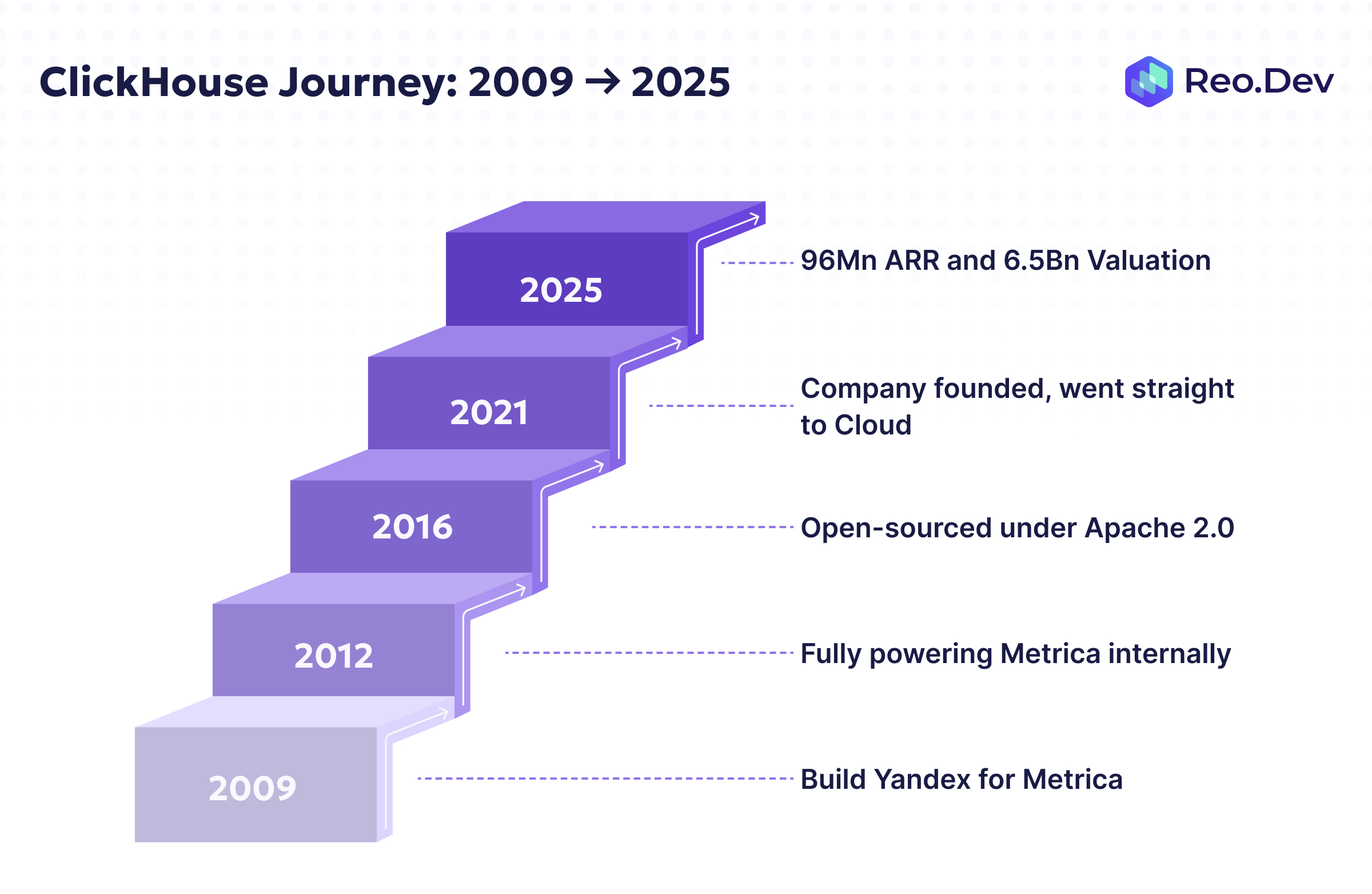
OLAP database space is a crowded one and has large legacy players like Postgres, MySQL, Oracle and many more. Clickhouse is a relatively new entrant: first built inside Yandex around 2009 and open‑sourced in 2016, before the commercial company was founded in 2021. And yet, if there was a Developer's choice award, it's pretty certain Clickhouse would take the cake.
In a recent Cloud 100 list published by Forbes, Clickhouse CEO pointed out that 40% of the Cloud 100 use Clickhouse, including 7 out of the top 10.
While many analytics platforms sprawled into feature bloat and lock‑in, ClickHouse stayed obsessed with one thing: speed. It became the go‑to database for developers running real‑time, petabyte‑scale analytics – from AI startups to infrastructure giants.
Today, ClickHouse powers over 2,000 paying customers and is valued at $6.35B.
Here’s how they did it.
Origin Story: Born Inside Yandex, Built for Real-Time Speed
Like so many powerful open source projects, Clickhouse was born out of a problem. It was born inside Yandex as an internal engineering lifeline, built by developers obsessed with solving a real problem that existing databases couldn’t touch.
Back in 2009, Yandex – Russia’s largest tech company – was hitting hard limits with its web analytics platform, Yandex.Metrica. The platform needed to ingest and query billions of events per day with interactive speed, but traditional databases couldn’t deliver the scale or sub-second latency required.
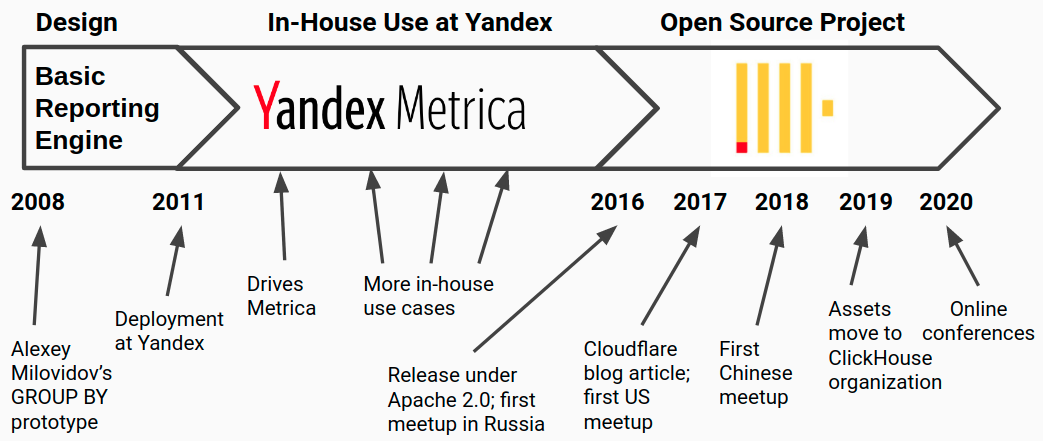
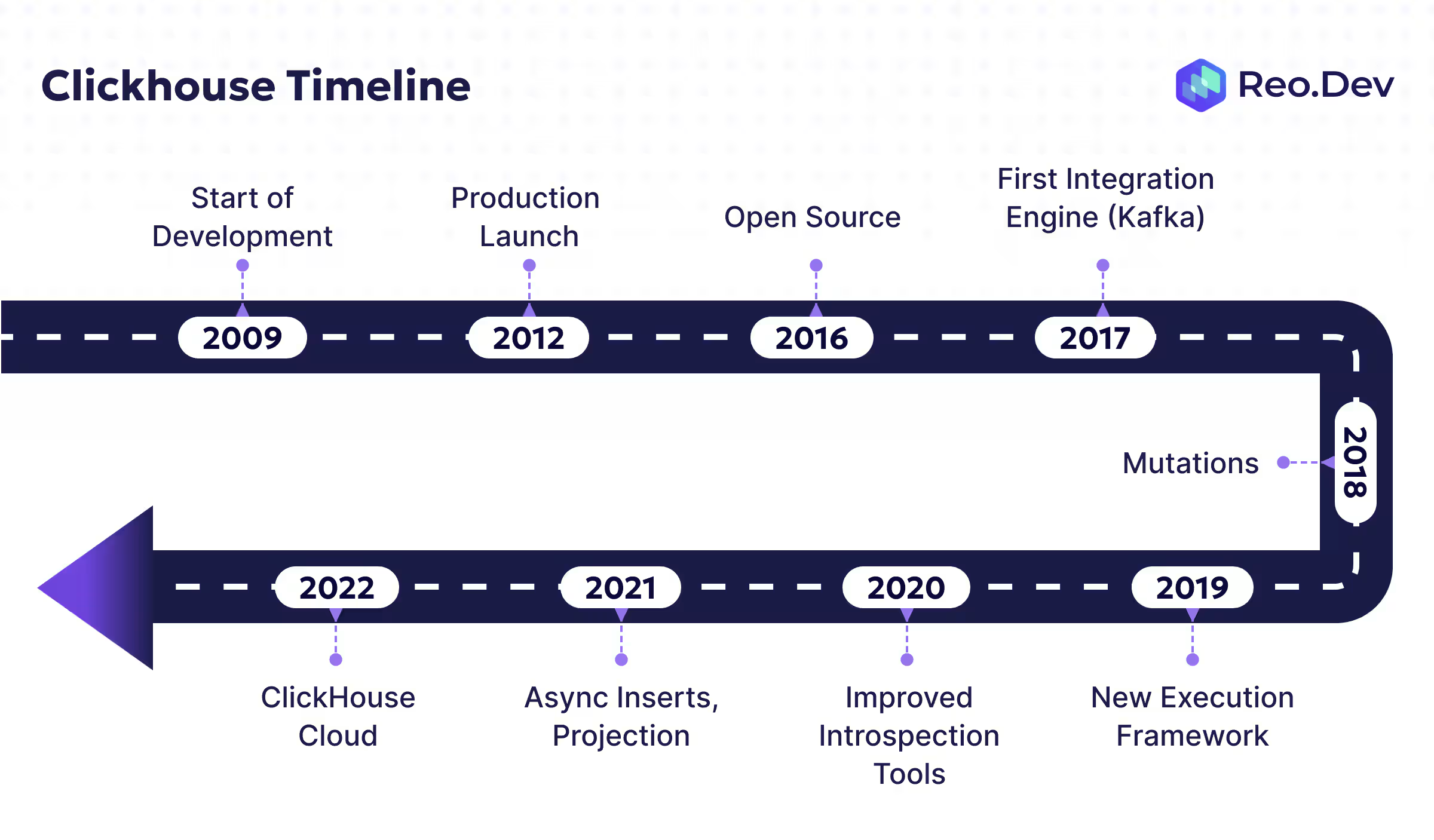
So engineer Alexey Milovidov and a small team decided to go at it and build their own. They iterated through early designs (like MyISAM and LSM‑tree approaches) before landing on a columnar OLAP engine that worked. By 2012, that tool – ClickHouse (short for “Clickstream Data Warehouse”) – was powering Metrica’s core, crunching massive datasets in milliseconds. At the time, they were just solving their own problem; they couldn’t have known that this internal project would one day become shorthand for high‑speed analytics far beyond Yandex.
Over the next few years, more Yandex teams adopted it internally. And in 2016, ClickHouse was open‑sourced under Apache 2.0.
That’s when things really took off.
Developer Adoption: How Developers Found ClickHouse
ClickHouse’s adoption story is a masterclass in pure developer‑led growth.
In 2016, a small Yandex team led by Alexey Milovidov moved the code to Github under Yandex and started issuing community builds, and began accepting external contributions.
But before it was ever open-sourced, ClickHouse spent nearly a decade running in production at Yandex, powering Yandex.Metrica - one of the largest web analytics platforms in the world. That internal use hardened the engine for real-time, high-scale analytics. So when it was finally open-sourced, developers weren’t getting a side project. They were getting something built for scale from day one.
Clickhouse started gaining massive traction – not because of any sales team or VC money - It took off because developers couldn’t stop talking about its performance. Excitement spread organically long before the company was launched in 2021.
- Open source release sparked curiosity: The performance numbers were hard to ignore. ClickHouse could scan billions of rows per second with sub-second latency - orders of magnitude faster than what developers were used to. Benchmarks comparing it to Redshift, BigQuery, and Elasticsearch began making the rounds on Hacker News and Reddit. Engineers frustrated with the limitations of their existing tools started trying it out. Curiosity quickly turned into adoption.
- The community amplified the story: There was no official GTM, but the developer community didn’t wait for one. From the very beginning, developers contributed blog posts, deep-dive tutorials, and real-world performance analyses. The first community meetup in 2016 drew over 200 attendees in person and another 400 online - most of them from Eastern Europe, where ClickHouse gained early traction.
As usage grew, so did community activity. Engineers used Slack to troubleshoot deployments, request features, and debate architecture. Talks at meetups and conferences found their way to YouTube, helping even more teams discover the project.
- Altinity helped bring ClickHouse to the West: In 2017, a US startup called Altinity - founded by ex-Yandex engineers with deep ClickHouse experience - stepped in to support the growing ecosystem. They built enterprise-friendly tooling (like a Kubernetes operator), contributed heavily to the open-source project, and launched Altinity.Cloud, one of the earliest managed offerings. Altinity became one of the top external contributors to ClickHouse, and a key bridge between Yandex’s engineering team and the broader global community.
- Endorsements from respected teams accelerated credibility: In 2017, Cloudflare published a detailed blog post on how they used ClickHouse to process over a million DNS queries per second. That post drove awareness and validated the project for infrastructure engineers everywhere.
By 2020, other high-scale teams at Uber and eBay had also gone public with their ClickHouse deployments. For many engineers, this signaled that ClickHouse was fast and mature enough for mission-critical use cases.
By 2021, ClickHouse had all the right ingredients in place: a production-hardened engine, a fast-growing open-source community, and real-world usage across companies like Cloudflare, Uber, and eBay. What it didn’t yet have was a company built around it - one that could invest in user experience, cloud delivery, and go-to-market scale.
That’s when Aaron Katz, former CRO at Elastic and SVP at Salesforce, stepped in. He partnered with ClickHouse creator Alexey Milovidov and Yury Izrailevsky (ex-Google) to form ClickHouse Inc. in 2021 Together, they raised $50 million from Index Ventures and Benchmark - and began building a commercial offering.
The Big Bet: Skipping Support and Going Straight to Cloud
By the time Clickhouse Inc was founded in 2021, developer momentum was already in full swing, the community was thriving, and engineers at top tech companies were running it in mission-critical environments.
But when it was time to monetize, the Clickhouse team didn’t take the typical open-source path.
Most OSS companies follow a well-worn route: start with paid support, introduce an enterprise edition, maybe sell proprietary plugins - and eventually graduate to the cloud. This staged approach helps generate early revenue and keeps things lean while the company figures out product-market fit.
MongoDB did it. Elastic did it. Confluent did it.
Having seen that journey firsthand at Elastic, Aaron Katz decided to do it differently at ClickHouse. Instead of retrofitting monetization onto the open-source project, the team would go straight to building what they believed users really wanted: a fully managed, cloud-native version of ClickHouse from day one.
The primary reason behind this move wasn’t just ambition, they believed that a cloud service will ultimately be the place where customers get the most value. Running ClickHouse in production was powerful, but operationally complex. Delivering it as a serverless cloud service removed that burden entirely, making the product radically more accessible. By doing the hard part of building out the cloud product first, they could come into the market with the end-state product and not tiptoe around some “halfway” business model.
As Tanya Bragin, VP of Product, put it:
“We believed that cloud would be where customers ultimately get the most value.”
So that’s what they built.
Instead of chasing early revenue, ClickHouse used its funding to go all-in on building the end product first: a fully managed, cloud-native version of ClickHouse.
From late 2021 to mid-2022, the team focused on engineering - rewriting core components for multi-tenancy, building a self-serve UI, and adding autoscaling and enterprise-grade security.
- May 2022: Private Preview launched with a few hundred OSS users testing real workloads. Usage-based billing quietly began. Here’s when Developer Relations was prioritized to drive Cloud beta adoption and community momentum.
- Oct 2022: Public Beta went live. The launch hit #1 on Hacker News, $300 free trials brought thousands of developers in, and many converted to paid - even before General Availability.
By the end of 2022, ClickHouse Cloud had already built early commercial momentum. But more importantly, it was validating that a cloud-first approach could work - without relying on support contracts or enterprise license deals.
Acquisition: Content, Community, and Cloud Marketplaces
By the time ClickHouse Cloud reached general availability in December 2022, the database already had a thriving open-source community. Developers knew ClickHouse was fast, and many were running it in production - self-managed, fine-tuned, and battle-tested.
But the commercial cloud version needed to win a different kind of trust.
ClickHouse Cloud promised a fully managed, serverless experience - with enterprise-grade security, SLAs, and seamless scaling. That meant developers had to evaluate not just the core engine, but how well it worked when someone else ran it for them.
To bridge that gap, ClickHouse focused on three core acquisition levers: technical content, community, and cloud marketplaces. Each one helped move developers from open-source awareness to paid usage of the cloud product.
Technical Content Built Confidence in the Cloud
Open-source traction gave ClickHouse strong brand recognition - but cloud adoption required a deeper level of confidence.
Developers who had previously run ClickHouse on their own machines now needed to understand how the managed version handled performance, observability, and scaling in a shared environment. Would object storage slow it down? Could autoscaling meet their latency requirements?
ClickHouse answered those questions head-on - through detailed, technical blog posts.
They covered advanced topics like:
- Scaling mechanics and query optimization strategies
- Monitoring data transfer and managing cloud-specific bottlenecks
- Database fuzzing with BuzzHouse (their internal test suite)
They also open-sourced their internal benchmarking framework - the same one the team used to test ClickHouse Cloud across providers, workloads, and configurations. For engineers comparing data warehouses, it became a trusted tool for real-world evaluation.
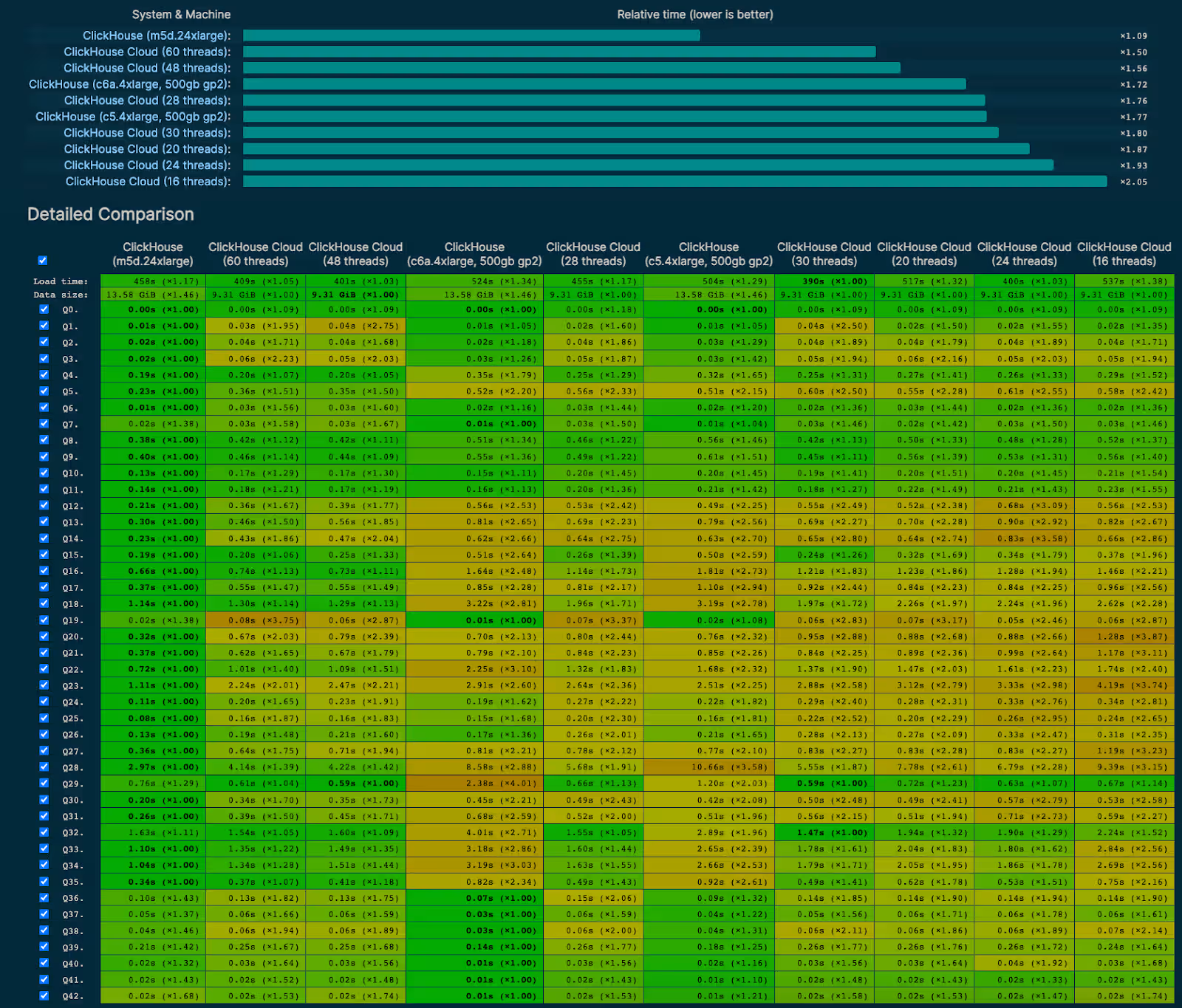
This chart shows how fast ClickHouse Cloud runs compared to running ClickHouse on your own servers (like on AWS machines).
As you'd expect, running ClickHouse on a powerful dedicated server (like m5d.24xlarge) is the fastest. But what’s impressive is that ClickHouse Cloud - especially the versions with more threads (48 and 60) - comes pretty close in speed, even though it's running in a shared, fully managed cloud environment.
For most teams, that small difference in speed is worth the tradeoff - because with ClickHouse Cloud, you don’t need to set up or manage any servers yourself. You get fast performance and you save a lot of time and effort on infrastructure.
While the goal was to build credibility, the content ranked well also - because it answered exactly what developers were searching for.
The community kept the momentum going
Before ClickHouse Inc. existed, the open-source community was already thriving. Developers across the world were sharing benchmarks, publishing blog posts, and helping each other troubleshoot issues in real time.
When the company was founded in 2021, the goal was to reinforce it - and make it a core engine for Cloud growth.What changed post-2021 was how the community plugged into ClickHouse’s GTM motion.
- Meetups and talks evolved: Earlier, meetups were general deep-dives into ClickHouse internals. Post-commercialization, the focus shifted to ClickHouse Cloud—with sessions on scaling in multi-tenant environments, live demos of the cloud UI, and product roadmap previews. These events, hosted across key cities and streamed on YouTube, helped thousands of developers understand what running ClickHouse in the cloud really looked like.
- Beta webinars converted interest into signups: In the lead-up to the Public Beta (Oct 2022), ClickHouse ran targeted webinars that showcased Cloud features in action. These were technical walkthroughs designed to help OSS users transition smoothly into the managed experience. Many of those attendees became early paid users.
- Community Stories Became Social Proof: Even before the cloud product existed, trusted voices like Cloudflare and Lyft were sharing how ClickHouse powered their real-time systems.But after the Cloud launch, those stories evolved:
From “Here’s why we use ClickHouse” to “Here’s how we scaled it with ClickHouse Cloud.”
- OSS Users Became the First Cloud Customers: ClickHouse’s open-source momentum gave it a built-in user base ready to try the cloud version. The team focused on converting this audience through tutorials, recorded demos, and community walkthroughs.
Cloud marketplaces unlocked enterprise reach
ClickHouse also recognized that many users wanted to consolidate billing through their existing cloud accounts. So they listed on major cloud marketplaces early, making it easier for teams to try, adopt, and expand ClickHouse usage without procurement hurdles.
Listing on cloud marketplaces helped ClickHouse reach more enterprise teams while also unlocking co-marketing opportunities, event participation, and direct connections through cloud partner programs.
Activation: Time-to-Value in Under 5 Minutes
Once developers landed on ClickHouse Cloud, the goal was simple: get them to value as fast as possible.
The team set a clear internal benchmark - a user should be able to sign up, start a service, load data, and run blazing-fast queries in under 5 minutes. That number shaped nearly every onboarding decision. It influenced how quickly services were provisioned, how sample datasets were presented, and how much automation was built into the early user flow.
But activation wasn’t just about showing off speed.
ClickHouse knew that developers needed to test the product with their own data, compare performance with other tools, and run realistic scenarios before they’d commit. The onboarding was fully self-serve, with built-in guidance, automated invites, and ready-to-run POCs - so teams could move from curiosity to conviction without ever opening a support ticket.
For private preview users, the team even created dedicated Slack channels so they could gather unfiltered feedback and help users work through roadblocks in real time.
Instead of a free tier with limited functionality, ClickHouse offered a 30-day trial with $300 in free credits - enough for most teams to complete a proper proof of concept at meaningful scale.The trial experience gave users full access to the product, making it easy to run real workloads and evaluate performance without restrictions.
Metrics That Guided the GTM
From the start, ClickHouse tracked a small set of metrics that showed whether their bottoms up motion was working and where they needed to focus next.
- How many users made it through the funnel: They looked at every stage - starting a trial, loading data, running queries, and becoming a paying customer - broken down by weekly and monthly cohorts. This showed if changes in onboarding or pricing were making it easier for users to convert.
- Which types of users were most successful: Usage was segmented by company size, geography, and the features being used. This helped confirm if they were attracting the right personas and where adoption was strongest.
- Whether accounts were growing over time: They tracked total storage and compute usage across accounts. A steady increase often signaled that a customer was ready for expansion conversations.
- Who might be slipping away: Churn wasn’t measured only by cancellations. A drop in usage or queries was an early red flag - giving the team a chance to step in before the account left completely.
By keeping a close eye on these signals, ClickHouse could make sharper product decisions, tweak pricing, and help the sales team focus on the accounts that mattered most.
High-Context Sales Motion Built Around Product Usage
ClickHouse’s sales strategy was deeply shaped by how developers discovered and adopted the product. With a strong inbound engine already in place, the sales team focused less on cold outbound and more on helping users who were already trying, evaluating, or scaling ClickHouse.
Between 2021 and 2023, the core motion revolved around two types of inbound engagement:
- Developer-led usage support - An individual developer might hit a snag while onboarding data or optimizing queries. These cases didn’t need a full sales cycle, just thoughtful technical guidance to unlock usage.
- Enterprise migrations - Larger companies looking to switch from legacy databases often needed deeper help: evaluation support, proof-of-concept guidance, and a clear business case for adopting ClickHouse. These cycles were more complex, but still developer-driven at the start.
To support both tracks, ClickHouse adopted a “cradle-to-grave” model - where the same sales rep handled everything from the first touchpoint to renewal and expansion. This approach came from Aaron Katz’s belief that involving too many roles (SDRs, CSMs, Sales Engineers) early in the journey often adds friction and slows things down.
Instead, reps were empowered to manage full-cycle relationships, which brought a few key advantages:
- Context carried forward 0 The person closing the deal already understood the customer’s use case, buying behavior, and procurement nuances.
- Stronger trust - Without constant handoffs, relationships felt more personal and responsive.
- Faster expansion - Because the rep stayed with the account post-sale, they were well-positioned to spot and act on growth opportunities.
Interestingly, many support queries - both pre- and post-sales - shared a similar technical nature, especially around onboarding, performance tuning, and scaling. Rather than spinning up a separate solutions engineering team, ClickHouse enabled its sales team to own those conversations directly. This kept things lean and avoided unnecessary layers in the customer journey.
For outbound efforts, the team relied on intent signals, not cold lists. If usage patterns showed a spike in queries, signs of production deployment, or advanced feature testing, sales reps would proactively reach out - offering help to optimize performance or scale usage.
This usage-driven sales motion allowed ClickHouse to stay efficient as it grew - aligning tightly with how developers adopt infrastructure tools and building deeper relationships without adding complexity too early.
The Results
By the time ClickHouse Cloud had a year in the market, the playbook was firing on all cylinders. Developers were discovering it through content and community, onboarding in minutes, and scaling their usage. Larger accounts were getting the guidance they needed through a lean, high-context sales team.
The combination of a strong bottom-up engine and targeted sales support turned early interest into long-term, high-value customers - and set the stage for the kind of growth most open-source companies take years to achieve.
- $96M in annualized revenue as of May 2025 - tripling in 12 months.
- Over 2,000 paying customers in less than three years.
- Valuation of $6.35B, backed by $650M+ in funding.
Strategic acquisitions like PeerDB and HyperDX expanded its capabilities in streaming and real-time workloads, reinforcing its position as the go-to analytics engine for the AI-driven era.
Key Takeaways from ClickHouse
- Find that one pain point - and go deep:
ClickHouse was born out of a real-world need: Yandex engineers needed to query billions of events with sub-second latency, and no existing database could keep up. So the engineers, obsessed with this problem, built one that could.
From those early days to the commercial cloud product, ClickHouse stayed focused on a single promise - being the fastest database for real-time analytics. That clarity shaped every decision. Developers facing latency issues didn’t need convincing - they instantly got the value.
- Community trust scales faster than ads ever will:
ClickHouse didn’t need ad campaigns to win trust. Public endorsements from Cloudflare, Lyft, and other respected engineering teams did the heavy lifting. These weren’t orchestrated testimonials - they were organic, highly technical write-ups that validated ClickHouse’s unique speed advantage for serious workloads.
- Remove friction around what devs already value:
Once developers experienced ClickHouse’s speed, the biggest obstacle wasn’t the product- it was the complexity of running it. So instead of monetizing through support or an enterprise tier, the team went all-in on a managed Cloud version. That bet paid off: developers didn’t need to be sold on why ClickHouse mattered - just given an easier way to use it.
- Turn product strength into an aha moment - fast:
ClickHouse set a ruthless internal goal: get users from signup to first blazing-fast query in under five minutes. That one benchmark shaped onboarding, sample datasets, and UI design. They knew their strength (speed) was undeniable - but only if users felt it immediately. The faster that moment came, the faster users moved from trial to conviction.
- Track the signals that matter:
From trial-to-paid conversion rates to storage and compute growth, ClickHouse’s telemetry told them who was finding value and who was slipping away. These signals guided sales outreach, product improvements, and expansion plays.
- Build high-context sales relationships:
ClickHouse’s “cradle-to-grave” sales model meant one person handled the customer from first touch to renewal. This kept context intact, built trust faster, and made expansion easier - while ensuring every sales conversation was rooted in a deep understanding of the customer’s use case and history.