


Developer discovery is changing quickly. Developers increasingly use AI tools to research technologies, understand technical concepts and compare solutions before they visit a product website or speak to a vendor.
The 2025 Stack Overflow Developer Survey found that 84% of developers are using or planning to use AI tools in their development process, while 51% of professional developers use them daily. The same survey found that nearly 68% of developers use technical documentation when learning new coding skills, making documentation the most used learning resource in the survey.
These two findings together point to a major change in the developer journey. AI is becoming part of how developers find and understand information, while technical documentation remains one of their most important sources of technical knowledge.
Research from Infrasity adds another layer to this shift. In its analysis of 147 live documentation pages across 49 widely used developer tools, Infrasity found that 78% publish an llms.txt file and 73% serve their pages as plain Markdown. Yet across 789 content headings, only 3.8% were structured as questions resembling the language developers use when looking for technical information.
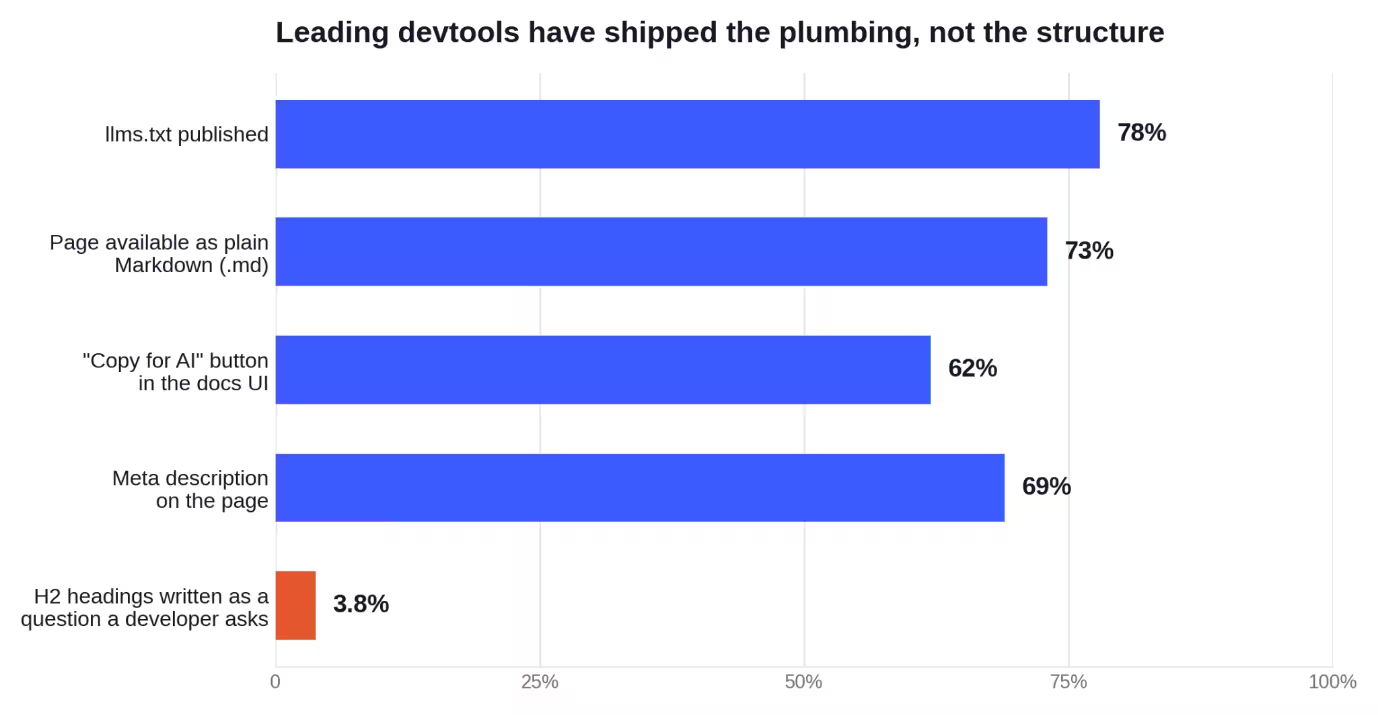
The infrastructure for machine access is developing rapidly. The bigger opportunity is making the information within that infrastructure easier to retrieve, understand and use.
1. Documentation and the Shift to Agent-Led Discovery
For developer-focused products, technical documentation is often where evaluation gets real. A developer may discover a product through search, a recommendation, a community discussion or an AI assistant, but the next question is usually technical: Can this actually work for my use case?
That is where documentation comes in. Before committing time to a trial or bringing a product into a technical discussion, developers look for evidence around integrations, supported frameworks, APIs, configuration, dependencies, deployment environments and implementation requirements. Documentation can therefore influence evaluation long before a developer speaks to sales.
What is changing is how the developer reaches that information.
The traditional journey was largely developer-led. A developer identified a problem, searched for potential solutions, shortlisted products and then went through their documentation to assess technical fit.
AI-assisted discovery introduces another layer. A developer can now describe the problem directly to an AI assistant and ask it to identify suitable technologies, compare options or explain how a particular solution could work within an existing stack. The initial discovery may therefore happen without the developer visiting a product website or searching for a specific vendor.
This creates an important shift from developer-led discovery to agent-assisted discovery.
The AI system becomes an intermediary between the developer and the technology provider. To recommend a product accurately, it needs to understand what the product does, where it fits, what it supports and how it is implemented. Technical documentation is one of the key sources from which that understanding is built.
This makes documentation important not only after a developer has found a product, but also during the discovery and evaluation process that comes before adoption.
The result is a developer journey with a new intermediary. Developers still make the technology decision, but AI systems are increasingly participating in the research and evaluation that happens before that decision.
Documentation therefore needs to serve both the developer who ultimately validates and implements the technology and the AI systems that increasingly help surface and compare technical options.
2. Why technical documentation needs a new approach
The strongest documentation starts with the way developers use a product rather than the way an organisation has structured its engineering teams.
A documentation site may organise information around:
- APIs
- Features
- Services
- Modules
- Releases
- Product architecture
Developers often organise their research around:
- A specific implementation
- An integration
- A technical problem
- A framework
- A deployment environment
- A desired outcome
Both structures contain valuable information. The opportunity is to connect the two so that technical information can be understood in the context in which it is needed.
Consider a developer integrating an authentication service into an application. The developer needs to understand the authentication method, supported frameworks, configuration, required credentials, code implementation and expected response. A strong documentation journey brings these elements together so that the developer can move from understanding to implementation with minimal friction.
The same structure also gives AI systems more useful context when individual sections are retrieved outside the full documentation journey.
A code snippet, for example, becomes more useful when it includes:
- The environment where it runs
- Required dependencies
- Authentication requirements
- The relevant product version
- The expected result
- Links to related implementation guidance
This is not about making documentation longer. It is about making each piece of information more complete and useful when encountered on its own.
Structure carries meaning
Headings, subheadings, examples and links create the structure through which technical information is understood.
A page with a clear hierarchy allows a developer to scan it quickly and reach the relevant section. The same structure helps an AI system identify which information belongs together.
Infrasity's finding that only 3.8% of 789 headings were structured as questions provides a useful signal. Documentation already contains substantial technical information. The opportunity is to organise more of that information around the language and intent developers use during research.
3. What AI looks for in technical documentation
The challenge is not simply whether AI can access a documentation page. It is whether the information it retrieves contains enough context to answer the question accurately.
When a developer asks an AI assistant how to configure an API, troubleshoot an error or implement an integration, the system may retrieve a specific passage rather than an entire documentation site.
That makes the quality of individual content blocks important. A useful passage should be understandable without requiring the reader or the AI system to reconstruct missing context from several other pages.
Three principles matter here:
Clarity
Each section should establish what it is about and explain the relevant technical concept directly.
An API endpoint description, for example, should make its purpose, inputs, outputs and intended use clear without forcing the reader to piece together information from unrelated sections.
Context
Technical information should remain useful when retrieved independently.
A configuration instruction is stronger when it includes the relevant environment, dependencies and expected outcome. A code example is stronger when the documentation establishes the version, prerequisites and expected result.
Connection
Related information should be connected through meaningful internal links.
Links between concepts, implementation guides, API references, examples and configuration instructions help developers move through a technical journey. They also provide clearer signals about how different pieces of information relate to one another.
Citability becomes increasingly valuable
Technical content can now appear in an AI generated answer without the developer first visiting the original documentation page. This makes the quality of the source material particularly important.
A strong technical passage gives an AI system enough context to represent a product accurately. A precise explanation of a feature, supported by implementation details and relevant conditions, creates a stronger basis for an answer than a short feature description alone.
This matters because developer trust in AI remains closely connected to the quality of its answers. Stack Overflow's 2025 Developer Survey found that 46% of developers distrust the accuracy of AI tools, compared with 33% who trust them.
That gap increases the value of authoritative technical documentation. Developers can use AI for speed and breadth while returning to reliable documentation for validation and implementation.
Documentation and AI discovery are becoming connected
The State of Docs 2026 report found that AI-powered search accounts for 35% of documentation discovery, compared with 45% for traditional search. Among enterprise companies, AI-powered discovery reaches 46%.
The numbers point to a broader change: documentation is no longer consumed only through the traditional documentation site. It increasingly has to work across search, direct developer research and AI-assisted discovery.
This is where technical documentation moves beyond being a collection of reference pages. It becomes an information system that represents the product to developers and increasingly to the AI systems helping them make technology decisions.
4. The Building Blocks of AI-Readable Documentation
The following framework, developed by Infrasity, focuses on the structural elements that can make technical documentation easier for AI systems to retrieve and use.
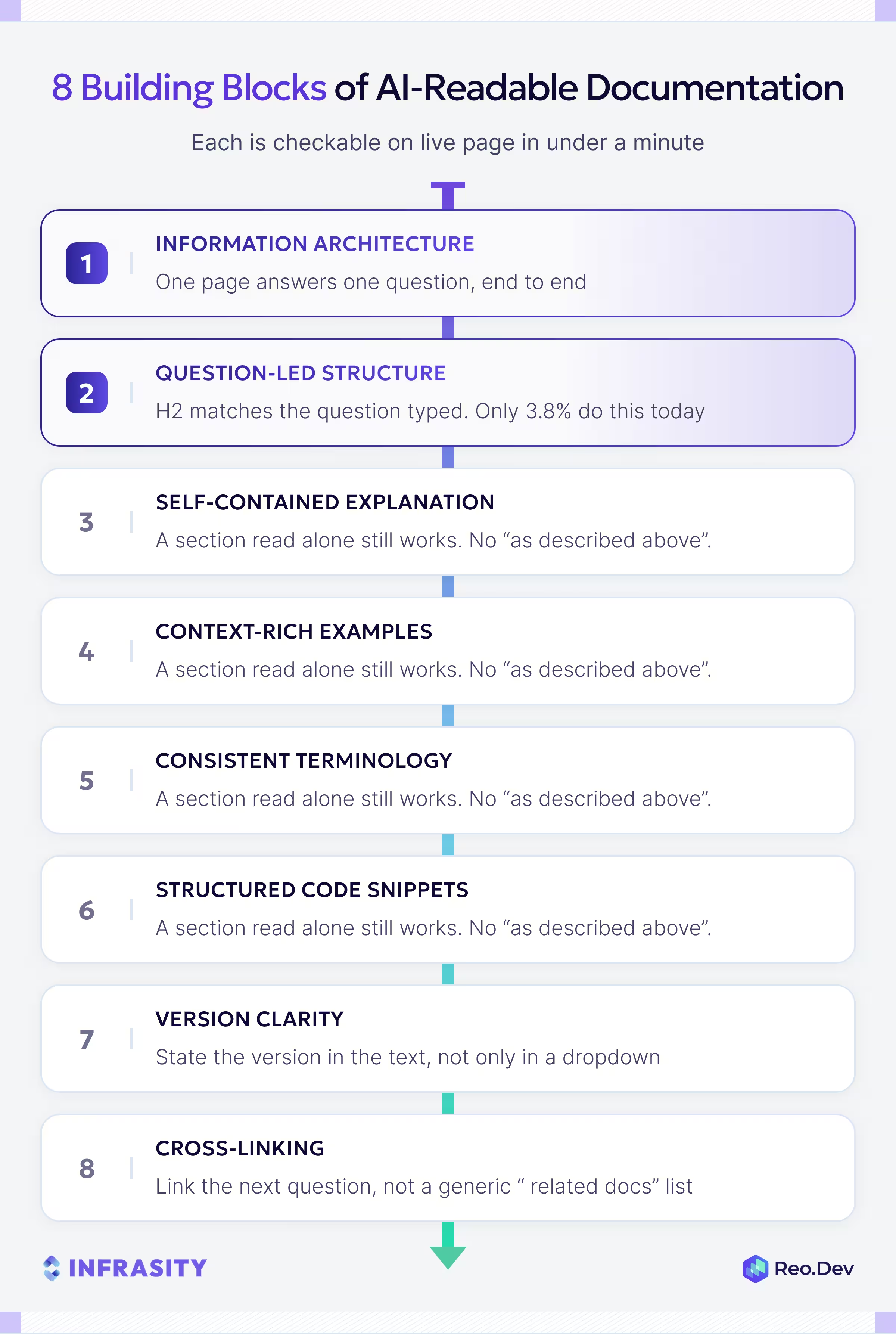
The first two blocks decide whether a passage can be retrieved. The remaining six decide whether it gets quoted once it is.
1. Information architecture
One page answers one question, end to end. If finishing the task needs a second tab, the page is a fragment.
Tabbed docs can fail here quietly. On Supabase's server-side auth page, only the Next.js panel has content in the raw HTML. The other eight framework panels are empty divs that fill when a human clicks. Complete in a browser, one-ninth complete to everything else.
2. Question-led structure
The H2 is the query. Infrasity's audit found 3.8% of headings written as a question; re-running the count on a fresh sample of 25 Markdown pages returned 5 of 202, or 2.5%.
Two samples, same answer. "Parameters" declares nothing about which question the chunk below it answers. "Which parameters are required to create a subscription?" declares it exactly. Same content, different retrieval.
Task-led headings are correct for procedures, and 20.3% of the field already uses them well. Reserve the question form for pages that resolve a decision or a failure.
3. Self-contained explanations
A section read alone still works.
The obvious version of this, "as described above," is already rare: zero of 202 sections in the sample used a back-reference phrase. What survives is unexplained state.
A section that calls client.messages.create() without saying where client came from reads fine to a proofreader and breaks the moment it is lifted. One clause fixes it: "using the client created in step two."
4. Context-rich examples
Show the input, the call and what comes back, including the failure case.
Error responses are the most retrieved category of docs content, because a developer searching at 2 am is searching for a status code. A page that shows a 200 and omits the 429 skipped the question people arrive with.
5. Consistent terminology
One name per object.
This is a retrieval issue, not only a style issue. Most systems pair embeddings with BM25, which matches exact strings.
When the same object is "API key" on the quickstart, "token" in the reference and "credential" in troubleshooting, that signal splits three ways.
Renaming is fine if you publish the mapping. Supabase's API keys page tables every legacy name against its replacement and states the deprecation window in prose, so one chunk carries both vocabularies.
6. Well-structured code snippets
Mostly solved, and worth saying so.
Of 104 JavaScript, TypeScript and Python blocks in Infrasity's sample, 87 (84%) included their own imports. The remaining 16% fail the same way every time: the block assumes a client instantiated further up the page.
Repeat the import.
7. Version clarity
A version dropdown is UI, not content, and it does not travel with the chunk.
Only 4 of 25 pages sampled carried a last-updated date anywhere in their Markdown copy. Anthropic's API overview does it right by putting anthropic-version: 2023-06-01 in the headers table as body text.
8. Cross-linking
Link the next question, not a generic "related docs" list.
"Once the client is authenticated, handle the 429 before going to production" states a relationship an anchor list cannot.
On the machine side, the llms.txt v2 proposal recommends declaring Markdown copy with rel="alternate" and type="text/markdown", which can be set as an HTTP header at the CDN without touching a page.
Two of these are worth prioritising immediately. Rewrite the headings on your twenty highest-traffic pages so each names the question below it, then confirm those pages return their full text to a plain curl.
Teams rebuilding docs rather than patching them can turn to Infrasity's technical content writing services for structural work.
Documentation is now a strategic GTM asset
Documentation increasingly contributes to the same outcomes as other go to market channels.
It helps a developer discover a capability.
It helps an engineering team evaluate technical fit.
It helps a developer move from evaluation to implementation.
It helps a prospective customer build confidence before engaging with sales.
The State of Docs 2026 report found that 35% of documentation discovery now comes through AI-powered search, rising to 46% among enterprise companies. That makes documentation increasingly relevant to the way products are discovered and evaluated.
This changes how companies can think about documentation.
A documentation page explaining an integration can support a developer who is evaluating the product.
A comparison page can help a technical buyer understand where a capability fits.
A detailed implementation guide can reduce the effort required to reach a successful trial.
A current API reference can strengthen confidence during technical due diligence.
These are direct contributions to the buying journey.
Documentation needs shared ownership
A strong documentation strategy brings several functions together.
Engineering contributes technical accuracy.
Product contributes product knowledge and use cases.
Developer relations contributes insight into developer behaviour.
Marketing contributes positioning and market understanding.
Documentation teams bring structure, editorial discipline and consistency.
This shared approach also creates stronger accountability. Documentation can be measured through metrics such as
- Time to first successful implementation
- Completion of key developer journeys
- Documentation assisted trial activation
- Search and AI discovery
- Content freshness
- Accuracy across product versions
- Developer feedback
- Documentation influenced leads
These measures connect technical content with product and commercial outcomes.
The opportunity is particularly strong for developer focused companies because documentation often represents the most direct demonstration of the product. Developers can read a positioning statement in seconds, while documentation lets them see how the technology works within their own environment.
That makes documentation part of the product experience and part of the company's go to market engine.
Conclusion
Developer discovery is becoming more direct, more conversational and increasingly supported by AI. The developer journey now moves between AI assistants, technical documentation, community knowledge and product websites, with each source contributing to the final technology decision.
The data shows why documentation deserves greater strategic attention.
Infrasity's research found that 78% of the documentation sets reviewed publish an llms.txt file and 73% serve pages as plain Markdown, while only 3.8% of the 789 headings analysed were structured around developer questions.
At the same time, 84% of developers are using or planning to use AI tools, nearly 68% use technical documentation as a learning resource, and 35% of documentation discovery now comes through AI-powered search.
The opportunity now sits in bringing these developments together.
Technical documentation can become easier for developers to discover, easier for AI systems to interpret and easier for businesses to connect with adoption. Clear information architecture, useful examples, consistent terminology, strong context and current technical references create the foundation for that shift.
For technology companies, this represents a new opportunity to treat documentation as a product, discovery channel and GTM asset at the same time.
Build documentation that works for developers and AI
ReoDev helps technology companies make their technical documentation more discoverable, structured and useful for both developers and AI systems. From identifying gaps in documentation structure and developer journeys to improving content for AI-assisted discovery, ReoDev helps teams turn documentation into a stronger product discovery and adoption channel.
Book a demo with Reo.Dev to see which developers are evaluating your right now
Infrasity brings technical content and developer-focused documentation expertise, helping companies create the implementation guides, examples and technical resources developers need to evaluate and adopt a product.
Book a discovery call with Infrasity to strengthen implementation content and developer adoption