


Why your intent data isn't turning into pipeline
Finding Waldo is hard!
Finding the accounts that are ready to buy from you shouldn't be. But if you sell to technical teams (read: the people who invented 'unsubscribe'), it usually feels even harder.

So you turned to intent data for help, and here's how that usually goes:
It told you 400 accounts were surging on DevOps, so your reps worked every single one. But, the surge turned out to be someone in finance googling 'what is Kubernetes' before an all-hands.
Most intent data was built for buyers who browse review sites and download whitepapers.
Engineers would rather debug in production on a Friday afternoon than do either, and on the rare occasion they do fill in your form, it's as asdf@asdf.com from a company called Acme.
Instead, they skip straight to trying your product: reading the docs, installing it, testing it on their own and, more and more often, sending an AI agent to do the evaluating for them.
And, btw - they do all this without saying a word to anyone at your company (for engineers, incognito isn't a browser tab, it's a lifestyle).
Good news: all of that is buying intent.
But the challenge is that nothing in your GTM stack is built to read it. Most stacks have two layers:
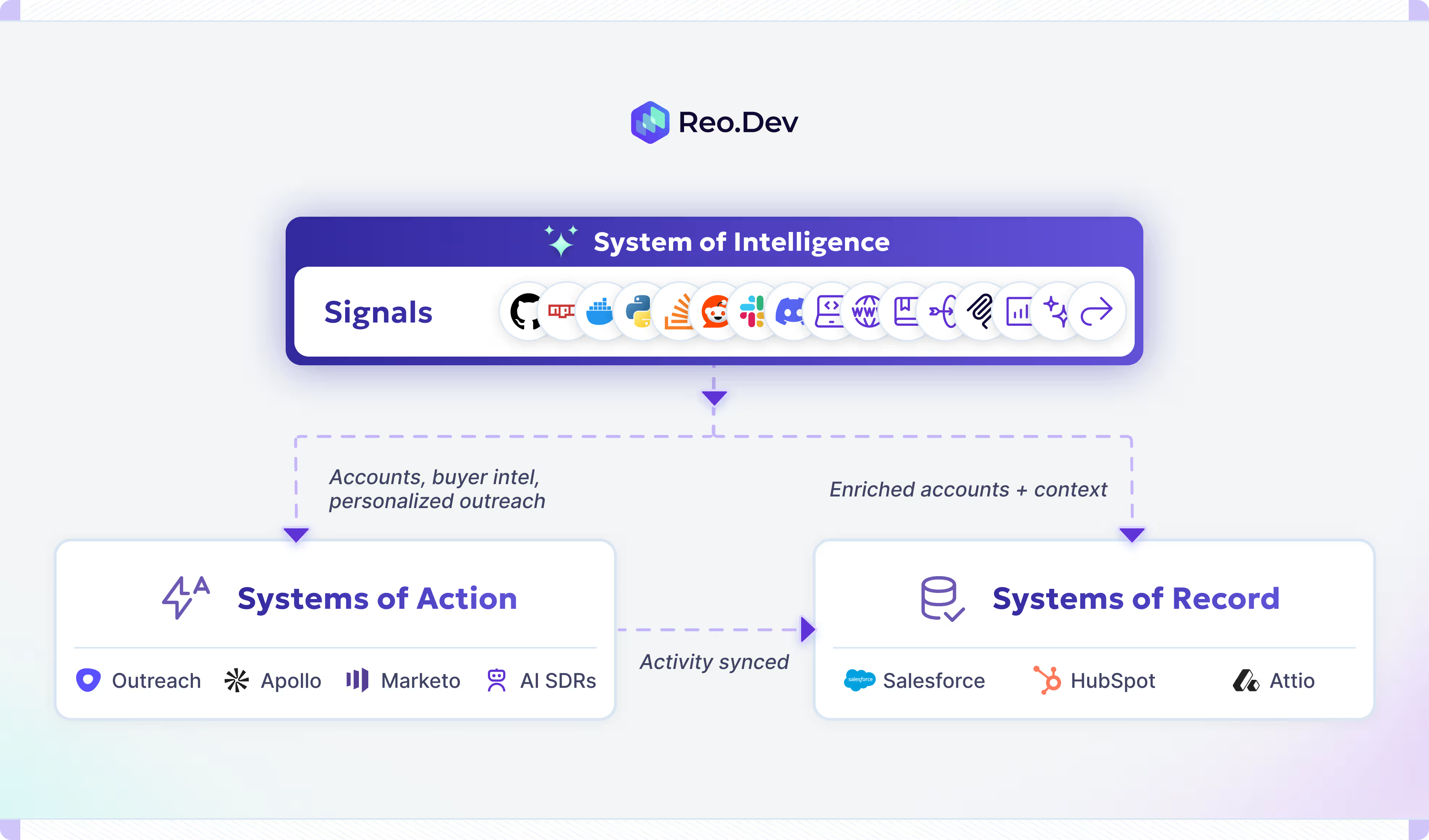
- your system of record (Salesforce, HubSpot or Attio) remembers every account you've already touched
- your systems of action (Outreach, Apollo, Marketo and the AI SDR you just rolled out) execute whatever you point them at
What almost no one talks about is the layer missing above them, even though it decides whether the other two ever make you money.
- Without it, your best-fit accounts evaluate you, shortlist a competitor and sign the contract, all without ever showing up in your CRM.
- Meanwhile, your AI SDRs get faster every quarter at emailing people who were never going to buy.
And you'll never see any of this on a dashboard, because a deal you didn't know existed can't show up as lost. That missing layer is the system of intelligence.
A system of intelligence is the layer that makes that decision. It works out which accounts are ready to buy right now, who you should speak to and why, so your team is never flying blind.
Here's what it runs on, how Reo Agents keep it fed and what changes for your team once they do.
What your system of intelligence runs on
Your system of intelligence is only as good as the signals you feed it, and this is where most intent data doesn’t help much.
Think of it like this - a shallow signal tells you someone walked into a hardware store. A deep signal tells you they're halfway through a kitchen remodel, the cabinets are picked and their partner's holding the credit card. Both are intent, but only one is worth walking over to say hello.
In tech GTM, the hardware store visit is a topic surge or a whitepaper download. The kitchen remodel looks more like this:
- They're mid-migration: they're hiring OpenShift engineers, their VMware roles are drying up and their developers are reading your migration guides
- They're about to buy: a new VP of Platform joined last month, the platform team just posted 3 roles in your category and traffic to your docs has spiked
- Your open source users want more: pulls of your image are climbing across several teams, they're running a self-hosted deployment and someone just opened your enterprise pricing page
Most intent tools can't help you identify signals like these. On the other hand, this is home turf for Reo.
Take the migration example. To spot it:
- you need to know a platform team from an MLOps team (Reo maps 250+ engineering teams, where most tools stop at about 20)
- you need to see who's installing your packages and pulling your images (Reo tracks installs across 40+ package managers, plus Docker pulls and OSS telemetry),
- and you need to know which engineer is behind the activity, not just which company (Reo's identity resolution matches 4x more GitHub profiles)
But even with all that data, someone still has to play detective every morning: coffee in one hand and 14 browser tabs in the other.
- Who started hiring OpenShift engineers this week?
- Whose docs traffic just spiked at 2 am?
- Which of your champions just posted "Excited to share that I'm starting a new position…"?
Reo Agents ask those questions for you around the clock (and unlike the rest of us, they don’t need the coffee, pssst!)
Reo Agents: the signal hunters that power your system of intelligence
Which brings us back to Waldo, because owning the deepest store of technical signals is a bit like owning the biggest Where's Waldo book ever printed.
Every Waldo you're looking for is in there, but you'd need a lifetime to find them all.
Reo Agents do the looking for you.
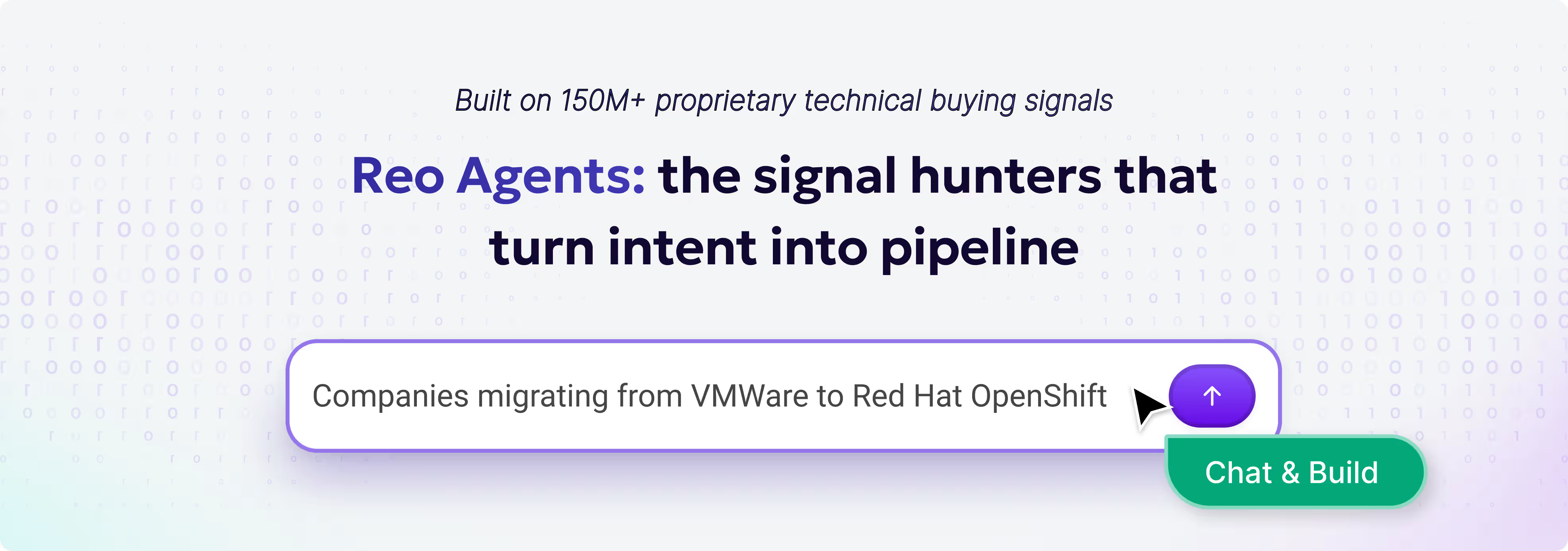
You tell Reo Agents what you're looking for in plain English, and they find a list of your target accounts showing those signals, explain why each one made the list and keep watching so new ones show up as your market shifts.
Everything they find feeds your system of intelligence, and from there your CRM, your sequences and your AI SDRs, so your whole stack works from the same signals.
And when the answer depends on several signals at once, they connect those too. Try asks like these:
- US Fintech companies migrating off VMware with 10+ DevOps engineers on the team
- Champions who switched jobs in the last 90 days to companies already running Kubernetes at scale
- Series B to D AI companies expanding their ML infrastructure team and hiring for Kubernetes
- Companies with 50 - 100 AI and ML engineers whose devs are engaging with our docs
To show what that looks like in practice, we gave the same question to Reo and to 3 well-known research tools: Clay, Exa and Claude.
We asked each of them which US companies are actively moving from VMware to Red Hat OpenShift right now.
Here’s the full bake-off, so you can judge the results for yourself:
What a system of intelligence looks like in practice
Remember those 400 accounts ‘surging’ on DevOps? Here's what the same Monday looks like once Reo Agents are feeding your system of intelligence:
And it shows up across the whole team:
- your SDRs work a short list with a personalized reason to reach out to every account
- your AEs walk into calls already knowing which team is driving the deal and what they've been reading
- Marketing stops paying to put ads in front of companies that will never buy, and moves that budget to the ones already leaning in
- and RevOps finally gets a CRM that reflects what's happening in the market, not just what reps remembered to log
The same goes for your AI agents:
- point an AI SDR at the left column (w/o Reo Agents) and it spams a thousand engineers before lunch
- but when you point it at the right column (with Reo Agents) and it works like your best rep on their best day
We’ll let you in on a secret - it's why we hold one principle above all at Reo: no developer should ever be spammed.
Coming up in Part 2: Agent Studio
This is the first blog in our series on the system of intelligence.
In the next post we'll open up Agent Studio, where Reo Agents, Agent Columns and the Agent Library come together, and walk through the exact workflows tech GTM teams run every week to turn signals into pipeline. If you'd like to see what Reo Agents can do for you, book a demo and we'll run it live with you


