





















Technologies
Debugging Tools
Developers using Swagger Inspector

Developers using Swagger Inspector

Swagger Inspector is an API testing tool that enables developers to validate and test RESTful APIs quickly, offering features like request validation, response visualization, automatic documentation generation, and seamless integration with Swagger/OpenAPI specifications.
Signals Header Bg Pattern - Decorative

Developers using Swagger Inspector

NAME
contact
DESIGNATION
COUNTRY
Company
Total tENURE
Eric Chu
AI Engineer
United States Country Flag Icon
United States
Salesforce Company Logo
Salesforce
12 years
Aria Fallah
Chief, Worse Engineering
United States Country Flag Icon
United States
Google Company Logo
Google
12 years
Alexandr Tumanov
DevOps Engineer
United States Country Flag Icon
United States
Amazon Web Services Company Logo
Amazon Web Services
9 years
Derek Hannah
Founding Engineer
United States Country Flag Icon
United States
adidas Company Logo
adidas
16 years
Lucas Gomes
DevOps Engineer
United States Country Flag Icon
United States
Amazon Company Logo
Amazon
5 years
Alex Rasmussen
Consultant
United Kingdom Country Flag Icon
United Kingdom
Amazon Web Services Company Logo
Amazon Web Services
13 years
Demitri Swan
Senior Software Engineer
France Country Flag Icon
France
Medallia Company Logo
Medallia
10 years
Sidhartha Purushothaman
Technical Manager
United States Country Flag Icon
United States
CGI Company Logo
CGI
10 years
Maciek Kumorek
Senior Software Engineer
United States Country Flag Icon
United States
iTech US Inc Company Logo
iTech US Inc
8 years
Zhengkai W
Software Engineer
United States Country Flag Icon
United States
Snowflake Company Logo
Snowflake
3 years
Showing 10 of
7,904
results
Page 1 of
791
NAME
contact
DESIGNATION
COUNTRY
Company
Total tENURE
James Dabbs
Head of DevOps
United States Country Flag Icon
United States
Alma Company Logo
Alma
8 years
Tucker Chapman
Chief Cloud Engineer
United States Country Flag Icon
United States
Airbus Aircraft Company Logo
Airbus Aircraft
11 years
JP Earnest
Senior Cloud Engineer
United States Country Flag Icon
United States
YASH Technologies Company Logo
YASH Technologies
4 years
Zheng J
Senior Software Engineer
United States Country Flag Icon
United States
Nagarro Company Logo
Nagarro
7 years
Mark Mindenhall
Chief Software Architect
United States Country Flag Icon
United States
Everymind Company Logo
Everymind
29 years
Art R
Chief Software Engineer
United States Country Flag Icon
United States
Google Company Logo
Google
6 years
Pydev
VP Cloud Infrastructure
India Country Flag Icon
India
Tech Mahindra Company Logo
Tech Mahindra
4 years
Evgenii Ukhatyi
Senior DevOps Engineer
United States Country Flag Icon
United States
Girl Scouts of the USA Company Logo
Girl Scouts of the USA
16 years
Kent Rasmussen
Head of Engineering
United States Country Flag Icon
United States
Memorial Health Company Logo
Memorial Health
5 years
Kuldeep Mishra
Senior Devops Engineer
India Country Flag Icon
India
Altea Federation Company Logo
Altea Federation
5 years
Showing 10 of
7,904
results
Page 1 of
791

Want access to the complete contacts list?

Unlock the full contact information of
7,904
developers actively working with
Swagger Inspector
technology, including economic buyers data for each account, complete with verified contact information, role tenure, company context, and adoption signals.
Book a Demo

What would you like to do with developer-level contact data that are users of Swagger Inspector?

Build my target developer list or assign economic buyers leads to my sales team

Transform your desired technology user data into actionable sales territories by combining firmographic ICP criteria with real-time technology adoption signals. Traditional account assignment based solely on company size and industry leaves money on the table—successful DevTool sales teams prioritize accounts showing active technology expansion signals.

Strategic account prioritization framework

Building an effective Total Addressable Market (TAM) requires more than basic firmographic filters. Companies using your desired technology represent varying levels of buying intent depending on their implementation stage, team growth, and technology stack evolution. Learn our complete framework for building DevTool ICP account lists to establish the foundation for strategic account segmentation.
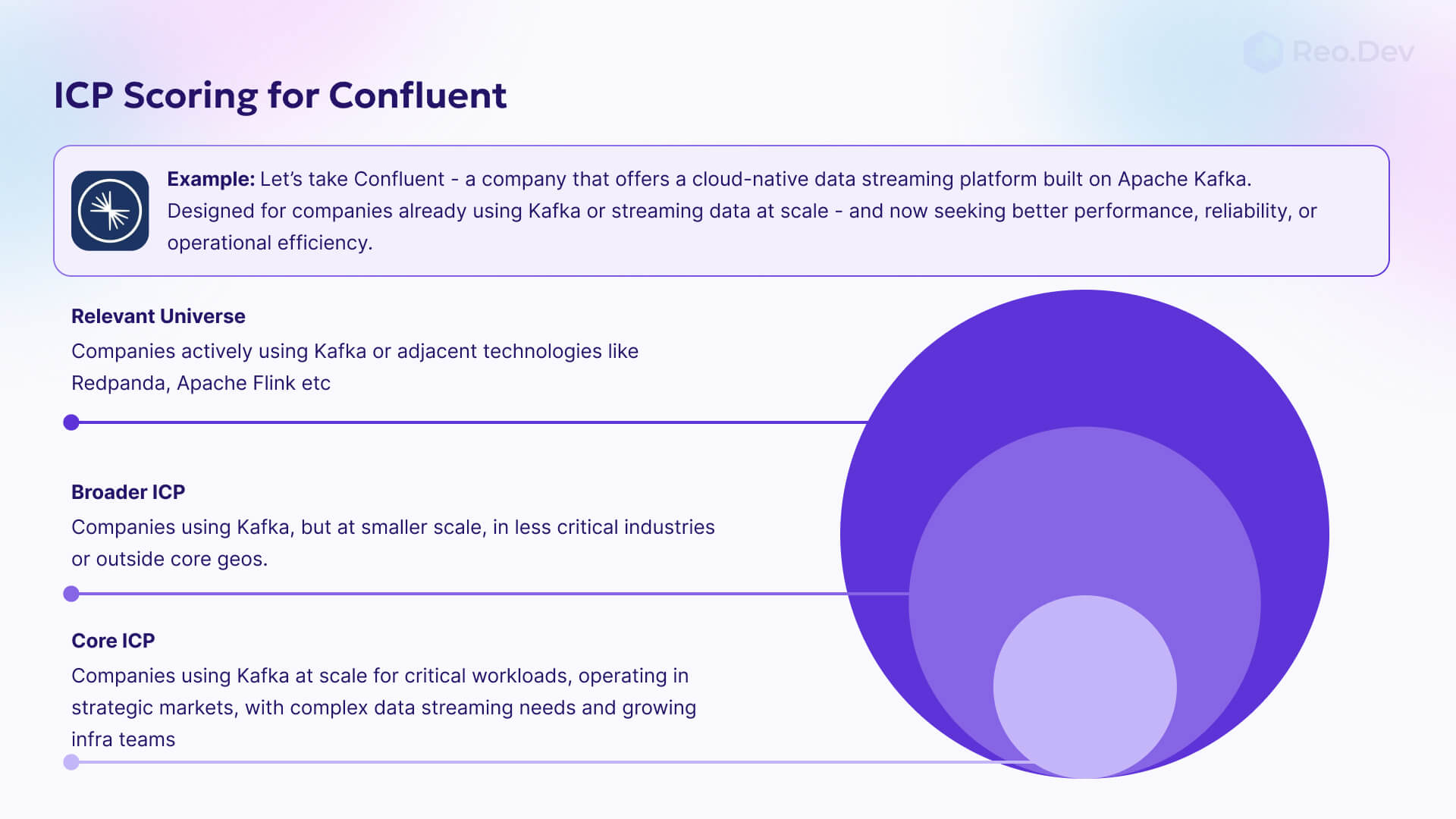
Confluent ICP scoring example illustrating core, broader, and relevant universe tiers based on Kafka adoption and data streaming scale

Standard ICP criteria—geography, industry, company size, revenue—only provide baseline qualification. High-performing sales teams layer technology hiring signals on top of firmographic data to identify accounts actively expanding their technical capabilities. Companies hiring  for your desired technology engineers or architects signal active investment in the technology stack, indicating higher purchase intent and budget availability.

In-market account identification and assignment

Priority account assignment should factor in recent technology hiring patterns as a proxy for market timing. Companies posting jobs for Redis engineers, Kubernetes specialists, or React developers demonstrate active technology expansion—making them significantly more likely to evaluate complementary tools within 90 days.

Our LinkedIn outreach playbook details the specific process for identifying and assigning these in-market accounts to sales teams. This approach increases meeting acceptance rates by 40% compared to generic outbound because prospects are already in active buying mode.

Territory assignment best practices

Tier 1 accounts: Companies using your desired technology with recent hiring activity for related roles. These accounts get immediate sales attention with personalized outreach referencing their specific technology initiatives and hiring needs.

Tier 2 accounts: Established desired technology users without recent hiring signals but strong firmographic fit. Assign these accounts for longer-term nurture campaigns and quarterly check-ins to monitor technology expansion signals.

Tier 3 accounts: Companies using your desired technology with weaker ICP fit or unclear expansion signals. Route these accounts to inside sales or marketing-qualified lead campaigns until stronger buying signals emerge.

Refresh account assignments monthly based on new hiring signals and technology adoption data. Companies can move between tiers quickly as their technology needs evolve, and sales territories should reflect these dynamic market conditions rather than static demographic assignments.

The combination of your desired technology usage data and hiring intelligence creates a predictive framework for sales success, ensuring your team focuses energy on accounts most likely to convert within the current quarter.

Learn more

Run marketing Campaigns

Leverage your desired technology user data to create targeted campaigns across three distinct audience levels: companies, developers (practitioners), and economic buyers. Each audience type requires different messaging, channels, and campaign strategies to maximize conversion rates.

Multi-level audience targeting

Companies: Target organizations using your technology of choice for account-based marketing approaches. Focus on company-level signals, firmographics, and technology stack intelligence to build high-intent prospect lists.

Developers (contacts): Reach practitioners who directly implement and use chosen technology. These technical decision-makers influence tool adoption and can become internal champions for your solution.

Economic Buyers (contacts): Target executives and budget holders at companies using your desired technology. While they may not use the technology directly, they control purchasing decisions and strategic technology investments.

Campaign strategies by audience type

ABM Google/LinkedIn Ads to your TOFU audience: Run account-based display campaigns targeting companies using containerization technologies like Docker or Kubernetes. Create awareness-stage content about DevOps optimization, infrastructure costs, or developer productivity to capture early-stage interest from decision-makers.

Invite developers to topical webinars: Host technical webinars for Redis users about database optimization, caching strategies, or microservices architecture. Developers using Redis are likely interested in performance engineering topics that showcase your platform's capabilities in a educational, non-sales context. Leading DevTools like Galileo and Camunda use this strategy effectively—see how they leverage expert-led sessions to grow their TOFU audience by educating and nurturing developer communities around emerging technologies.

LinkedIn outbound campaigns to developers or economic buyers: Execute targeted LinkedIn outreach to practitioners and buyers at companies using complementary technologies. See how Kubegrade leveraged Kubernetes user data to run successful LinkedIn and email campaigns, or follow our proven LinkedIn outreach playbook that helped Unstructured book meetings with economic buyers.

Competitor email campaigns based on competitor technology: Target companies using competing solutions like MongoDB (if you're in the database space) or Elasticsearch (for search solutions). Craft messaging around migration benefits, performance comparisons, or feature gaps that position your solution as the superior alternative.

Complimentary technology campaigns: Run campaigns to companies using GraphQL (if you provide API tools) or React (for frontend development solutions). Focus messaging on how your product enhances their existing technology investments rather than replacing them—creating additive value propositions.

Technical content nurture campaigns to developers: Send regular technical newsletters to PostgreSQL users featuring database optimization tips, query performance guides, or architectural best practices. This builds relationship equity with practitioners who influence purchasing decisions while demonstrating your platform's technical depth.

Campaign execution framework

Each campaign type works best when aligned with the prospect's technology maturity and buying stage. Companies actively expanding their technology usage often have budget allocated for complementary solutions, making them higher-intent prospects than those just beginning adoption.

Combine multiple campaign types for maximum impact: start with educational content to developers, then retarget engaged prospects with ABM campaigns to economic buyers at the same companies. This multi-touch approach increases conversion rates while building relationships across the entire buying committee.

Learn more

Tell us exactly what’s your use case

Send us your unique needs, we’ll get back to you in a jiffy!
By submitting this form, you agree to Reo.Dev's Terms of Service and Privacy Policy. We promise not to spam.
Thank you! Your usecase request has been captured. We will connect with you on your provided email soon.
Oops! Something went wrong while submitting the form.

How to target developers using Swagger Inspector

How to build your target account list?

Start by building your Ideal Customer Profile (ICP) universe using technology signals as a foundation. Companies using

Swagger Inspector

often share similar technical maturity and infrastructure needs, making them prime candidates for developer-focused solutions. Learn our complete framework for building DevTool ICP account lists to maximize your targeting precision.

Customize this data by filtering for geography, industry, company size, revenue, technology usage, job positions and more. Our platform provides technology intelligence at both company and individual levels—categorized into developers/practitioners and economic buyers within those organizations. This dual-layer approach enables precise targeting whether you're running ABM campaigns at the account level or personalized outreach to specific contacts.

Download your refined lists in Excel or CSV format, sync directly to your CRM (HubSpot, Salesforce), or use our APIs to send data to your warehouse.

How to get alerted when new developers are working on Swagger Inspector technology?

Set up automated alerts to capture companies as they adopt

Swagger Inspector

in real-time.

This gives your sales team first-mover advantage when prospects are actively evaluating and implementing new solutions—the optimal time for outreach.

Configure alerts based on your specific ICP criteria: get notified when companies in your target geography, industry, or size range start using your target technology. Alerts are delivered directly to your inbox with complete company and contact intelligence, enabling immediate, contextual outreach while the technology adoption signal is fresh.

How to sync this data with my CRM or sales stack?

Export technology user data seamlessly into your existing sales and marketing infrastructure. Direct CRM integrations with HubSpot and Salesforce automatically sync company and contact records with technology intelligence, enriching your existing database.

Use our API endpoints to send

Swagger Inspector

user data directly to your data warehouse, enabling advanced segmentation and analytics across your entire revenue stack. This approach works particularly well for companies running sophisticated ABM programs or complex lead scoring models.

The targeting strategy differs significantly between contact-level outreach and account-based campaigns. For individual targeting, focus on practitioners who directly use

Swagger Inspector

with personalized technical messaging. For ABM approaches, target economic buyers at companies using

Swagger Inspector

with broader business value propositions and multi-threading strategies.

Frequently Asked Questions (FAQ)

What is Swagger Inspector?

Swagger Inspector is a cutting-edge technology that falls under the category of API Testing and Documentation Tools. It serves as a free, online tool designed to simplify the process of validating and testing RESTful APIs without requiring any downloads or installations. Developed by SmartBear Software, the same company behind the popular Swagger framework, this tool allows developers to quickly execute API requests, validate responses, and ensure their APIs function as intended before deployment.

From a technical perspective, Swagger Inspector operates through a user-friendly web interface that enables developers to send requests to any publicly accessible API endpoint. The tool supports all standard HTTP methods including GET, POST, PUT, DELETE, and PATCH, making it versatile for comprehensive API testing. When a request is sent, Swagger Inspector automatically validates the response against OpenAPI specifications, highlighting any discrepancies or errors. Its architecture includes features for:

  • Request history tracking for easy reference and reuse
  • Response visualization in multiple formats (JSON, XML, HTML)
  • One-click conversion of API calls into OpenAPI documentation
  • Authentication support including OAuth, API keys, and Basic Auth

Swagger Inspector has gained significant adoption among development teams working in agile environments where rapid API testing and documentation are critical. Its seamless integration with SwaggerHub allows teams to transform successful API calls directly into formal API definitions, streamlining the documentation process. As APIs continue to form the backbone of modern software architecture, tools like Swagger Inspector play an increasingly vital role in ensuring API quality, consistency, and compliance with specifications across development lifecycles.

What is the source of this data?

We aggregate developer & company technographics intelligence from multiple proprietary and partner sources. Our platform monitors job postings across millions of companies—tracking listings on career sites, job boards, and recruitment platforms to identify technology adoption patterns and internal tool usage. This hiring signal data reveals what technologies organizations are actively investing in.

Beyond job data, Reo.Dev maintains a proprietary database of 30+ million developers and tracks activity across public GitHub repositories to capture real-time technology usage signals.

We supplement this with GDPR-compliant datasets from trusted data broker partners and visitor intelligence platforms, creating a comprehensive view of both company-level tech stacks and individual developer behaviors.

This multi-source approach ensures you're working with the most accurate, up-to-date company technographics & developer intelligence available.

How often is the data updated?

Our platform refreshes data daily, giving you access to the latest developer and technology intelligence. This continuous update cycle ensures your go-to-market teams are working with current information that reflects real-time market movements, emerging technology adoption patterns, and fresh hiring signals from across the industry.

How many developers use

Swagger Inspector
?
As of now, we have data on
7,904
developers that use
Swagger Inspector
.

How to find developers that use

Swagger Inspector
?

Visit reo.dev and use Reo.Dev's audience builder to search for developers using your desired technology—our platform analyzes job postings, GitHub repositories, and proprietary developer data to identify the  technology stack for any given organization. Book a demo with us today to get started.

How to get an updated list of developers that use

Swagger Inspector
?

Reo.Dev provides real-time access to companies using your desired technology of choice and thousands of other developer technologies. Our platform continuously tracks technology adoption signals from job postings, GitHub activity, and proprietary developer data to give you the most current view of which developers & organizations are actively using the technologies in their tech stack/developer profile. Simply search for your desired technology within our audience builder to generate a targeted list of developers—complete with their current company, seniority, years of experience, and tech stack intelligence at an account level. Book a demo with us today to get access to the latest data.